
Stories from Paul’s Kitchen
An older Caucasian couple was enjoying steaming bowls of soup and chow mein at Paul’s Kitchen, 1012 San Pedro Street near Tenth Street in Los Angeles. The man shared, “I’ve been coming here since I was a boy. We lived in San Gabriel then, and my parents had five kids. Sometimes the lines here were so long that I had to try to not lose my parents.” He continued, “I had some business today in downtown L.A., and came up from San Clemente”. San Clemente is about 60 miles away.
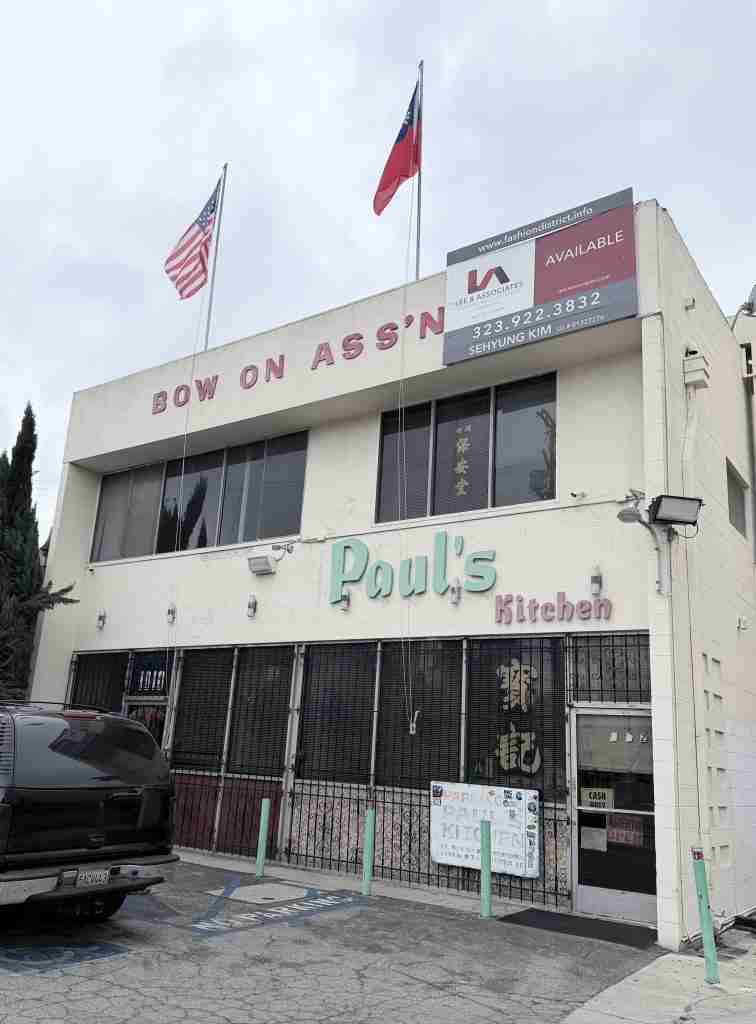 older Caucasian couple was enjoying steaming bowls of soup and chow mein at Paul’s Kitchen, 1012 San Pedro Street near Tenth Street in Los Angeles. The man shared, “I’ve been coming here since I was a boy. We lived in San Gabriel then, and my parents had five kids. Sometimes the lines here were so long that I had to try to not lose my parents.” He continued, “I had some business today in downtown L.A., and came up from San Clemente”. San Clemente is about 60 miles away.
Los Angeles’ Paul’s Kitchen was one of those “vintage” Chinese American restaurants known for large portions and reasonable prices that sustained many generations of workers and their families.
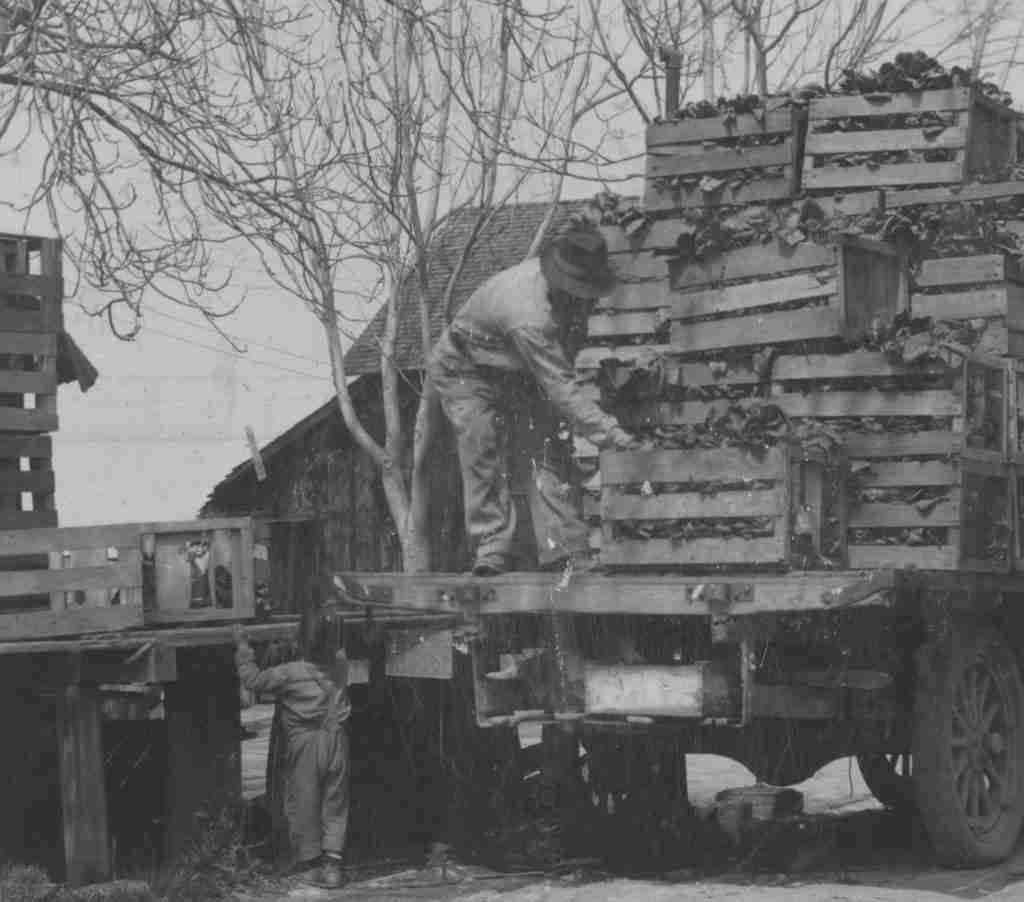
 Marked as “Seigo with Papa [Seki Sakamoto] loading spinach to market” from El Monte’s Sakamoto Farms in 1938. Photo courtesy of Amy Sakamoto Tsubokawa and the Pasadena Digital History Collaboration.
Location is everything, and Paul’s Kitchen was located near the City Market that was established in 1909. This wholesale produce market was once a bustling multiethnic community of Chinese, Japanese, and other entrepreneurs each day from 3 am. Chinese and Japanese farmers drove in with their fresh harvest from the San Fernando Valley, the San Gabriel Valley, the South Bay and elsewhere. The fruits and vegetables were redistributed to restaurants, grocery stores, and even some truck farmers. For a century, the City Market was an epicenter of food distribution for a growing megalopolis. The structure was shut down in 2009, and demolished in 2012.[1]
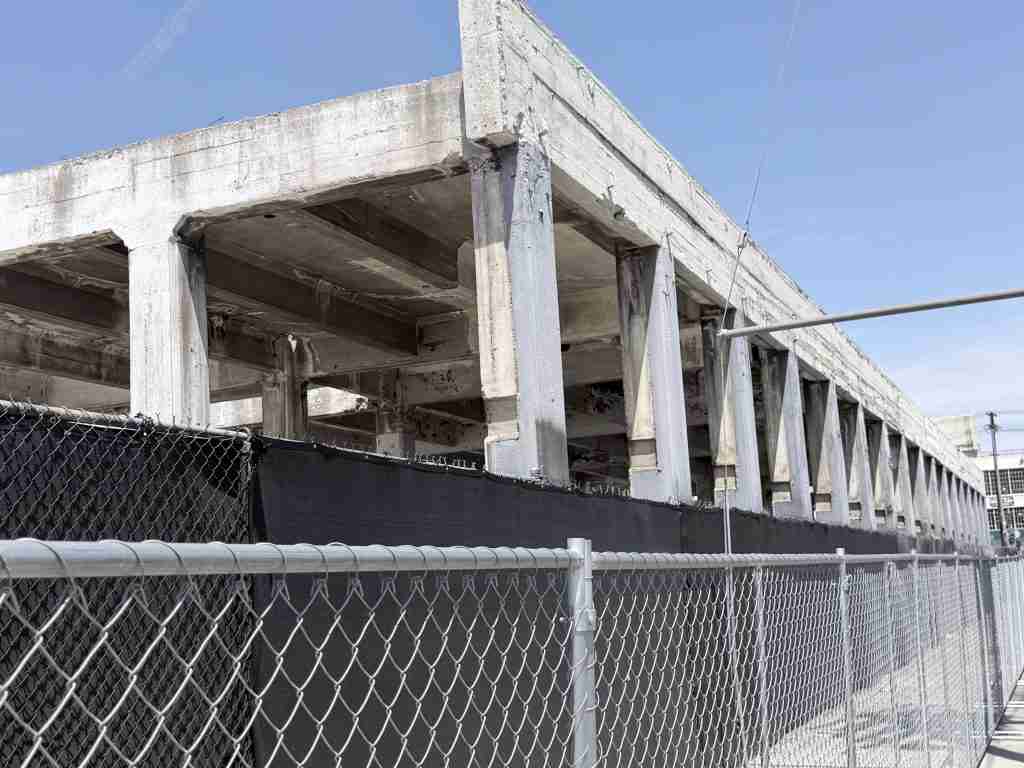
 City Market in 2026.
Because of their jobs at City Market, a group of Chinese Americans moved into the nearby East Adams district. Anchored by the Chinese Presbyterian Church, the Chinese Americans grew families between the 1930s and 1960s.[2]
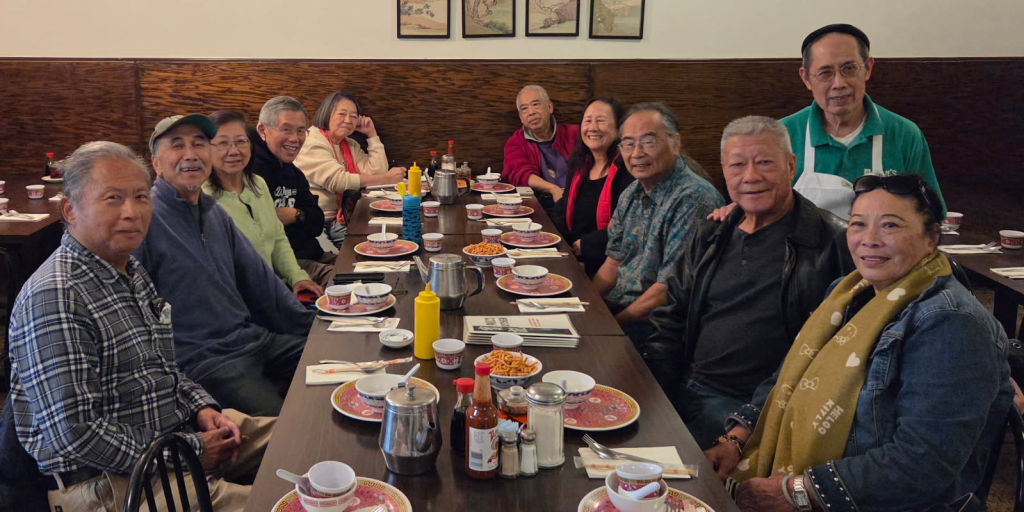
 On the right side from back: Jimmy Chen, Lila Quan, Gordon Hom, Richard Yee, Charlie Ng (standing) and Judi Wong. Left side from back: Susie Ling, Steve Quan, Anita Lee, Gary Wong, and Greg Wong. Photo courtesy of Gary Wong.
Knowing that this iconic restaurant may soon close, in January of 2026, ten of us Chinese American seniors made a lunch reservation at Paul’s Kitchen. First, we haggled about what to order, “They are known for their tomato beef chow mein,” said someone. “Their paper wrapped chicken is freshly made.” Someone else added, “How about the chasiu egg foo young.” “Ham yu of course,” yelled another. We got complimentary egg flower soup.
Lila laughed, “This is the comfort food from the old days – just like Mom made.” Lila knows Jimmy from Temple City. Jimmy came to L.A. in 1963 from Toisan in Guangdong province. He said, “This was the first restaurant I ever came to. I used to have a paper route delivering two Chinese language newspapers.” As I snacked on the wonton strips already set on the table, he observed wryly, “Whites used to eat these appetizers dipped in catsup and hot mustard…”
Lila said, “I was also born in Toisan and came when I was four in 1953. My six younger siblings were all born in Seattle. My dad came in his teen years as a paper son. Then he went back to China to find a wife. My parents had a similar restaurant in Seattle, and I was working there – without pay, of course – since I was twelve. This food is just like that from my dad’s restaurant. I came down to Los Angeles to go to college in 1968.”
Lila sat across from her ex-husband, Steve. Steve was born in Santa Monica. His dad was born in Oakland. The dad went back to China with his brother when the brother wanted to get married. Anti-interracial marriage laws restricted partnerships for Chinese Americans. Steve’s Dad didn’t want to marry anyone who didn’t speak English, but he took the opportunity of being in China to marry on paper a dead woman. In 1934, he found a woman who spoke English as she had gone to Maryknoll Convent School in Hong Kong. This bride then adopted the name of the dead woman.
Steve’s grandfather had been the “Butcher King” in Oakland. He had ten kids, and sent two sons to Santa Monica in hopes of expanding their business. But Uncle Andrew applied to Cal Tech. Steve continued, “Everyone said to Uncle Andrew, ‘why bother as you’ll never get a job!’ But WWII happened, and Uncle Andrew found work. My dad had finished Cal in three years; he was smart. He passed the civil service exam with flying colors. He worked at the Santa Monica post office for 35 years. He was known for never taking a sick day.”
After the Butcher King died, the grandmother refused to go back to China even though it was expected of her. Steve’s mom gave her money so Grandma could continue her American dream. Steve continued, “My mom never worked in China. In the U.S., she partnered with two others to establish a sweatshop, Ideal Fashion on Alpine.” Lila interrupted, “Actually, I put up $1000 and was their fourth silent partner. I wanted to support my mother-in-law. This was near 1969 or 1970.”
As a kid, Steve went to St. Bridget Chinese Catholic Center in Chinatown. One day, some of them were sent to a Hollywood set, and 10-year-old Steve was selected to be in a movie with Humphrey Bogart. He was paid $30 for his part in The Left Hand of God (1955).
These are some of our Chinese American stories…
Charles Ng, the proprietor of Paul’s Kitchen, came out in his green apron to say a hearty hello. He has been working here since 1993. He is now 77 years old and is really thinking about retiring. He is married to the sister of the wife of Alan Yee; Alan Yee was the paper son of Paul Yee – the “Paul” of Paul’s Kitchen.
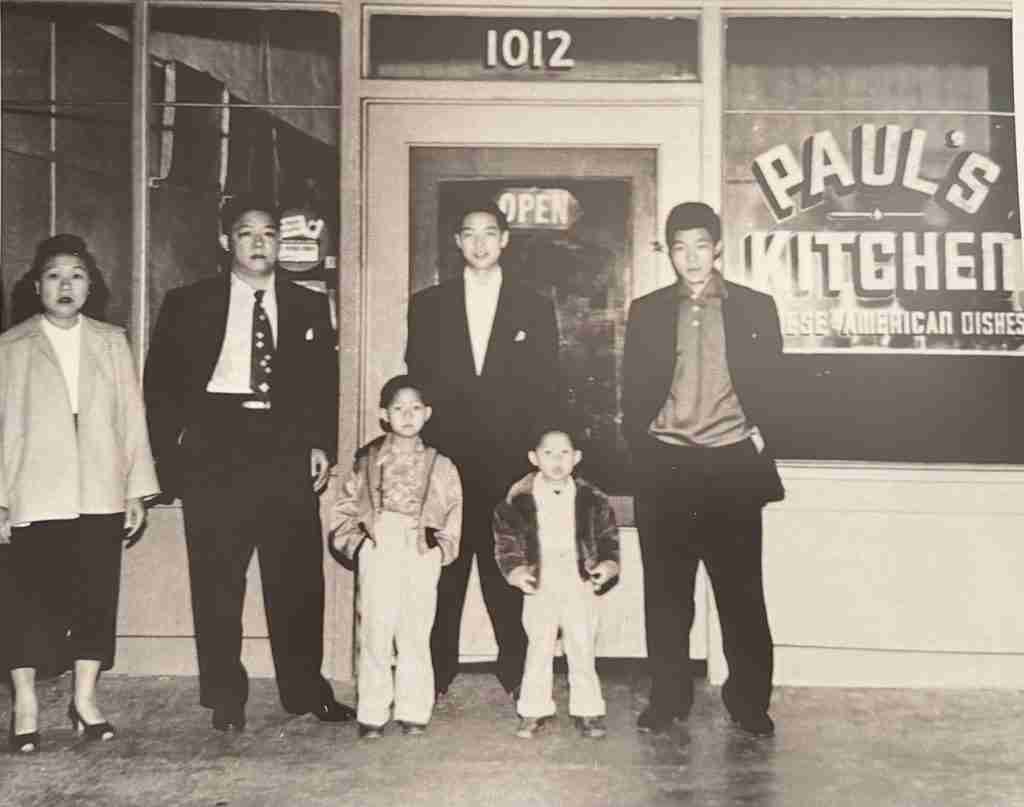
 Left to right: Mom, Paul Yee, Richard Yee, Alan Yee, Tom Yee, older brother circa early 1950s. Photo courtesy of Richard Yee.
Richard is the 78-year-old biological son of Paul Yee. He said, “My dad first came in the late 1930s with his older brother. They established Paul’s Café on San Julian Street in the City Market area… My oldest brother was born in 1935. Then Dad went back to Hong Kong and me and my younger brother, Tom, were born there. We came back to Los Angeles in 1952 – on an airplane. I remember on the flight, my dad said I had to finish the steak and tossed green salad” (laughs). Now more adopted to “American” food, Richard added, “The L.A. Conservancy say the restaurant opened in 1946 – but my brother was born in 1949 in Hong Kong so that doesn’t make sense.”
Since he was a boy, Richard – along with his brothers – was prepping vegetables in the kitchen. By the age of 8, he was cutting duck. “One time, this customer ordered fifty of our roasted ducks.” At first, the Yee family lived upstairs from the restaurant. Even today, although remodeled, there are boarding rooms upstairs – plus a second industrial kitchen. Then the Yee’s moved about two blocks away into the East Adams district, a multiracial suburban community. At the restaurant, there were always four or five waiters, some living upstairs and some college-bound. Richard continues, “My brother Tom and I are still silent partners in this restaurant. My dad was disappointed that I didn’t continue in the business. But he also told me to make more money. I became a plumber and then a building inspector.”
Paul’s Kitchen served many Chinese and Japanese American produce workers that would pop over for lunch and then bring their families for dinners. “We also had a lot of Jews visit us, and anything and everything,” said Richard. “We often had lines out the door. And there was always take-out.”
But the most beloved customer was then Dodger manager, Tommy Lasorda. In the 1970s, this was Lasorda’s regular spot for postgame meals. The restaurant featured a “Tommy Lasorda special” – wor wonton soup, egg rolls, chasiu pork, spare ribs, asparagus with beef, kung pao chicken plus house fried rice.
Richard explained that his dad did the cooking and Mom did the prepping. “My dad was a traditional strict Chinese father, and Mom really worked hard.” Richard continued, “I didn’t have much to do with this restaurant, but I’m proud of my family’s legacy as this is one of the oldest existing Chinese restaurants. We served and serve Americanized Chinese food.”
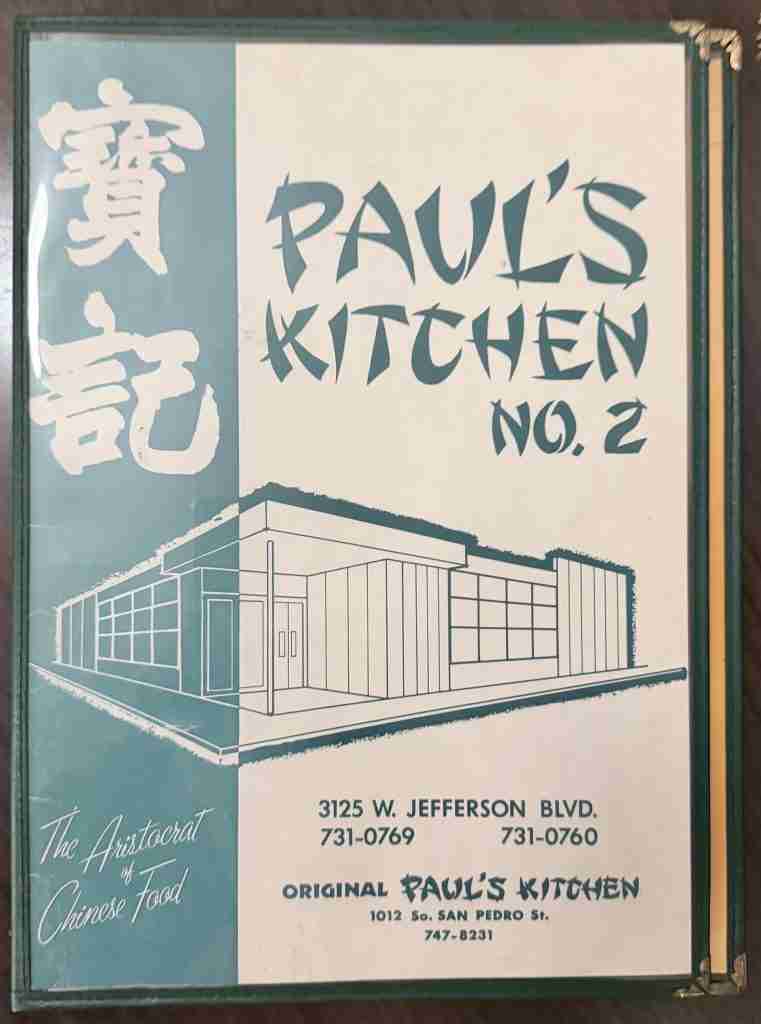
Between 1972 and 2010, Dad opened Paul’s Kitchen #2 at 3125 W. Jefferson, and Brother Tom opened a third location at 1950 S. Atlantic in Monterey Park. Judi Wong chimed in about the Monterey Park location, “Tom Yee played music there on Thursday evenings with his bandmates of Loco Mojo. There was no cover charge; we just had to order chow mein and a drink.” Chinese American kids from Belmont, Dorsey, Manuel Arts, Marshall, Roosevelt and Garfield High would attend these popular dances.
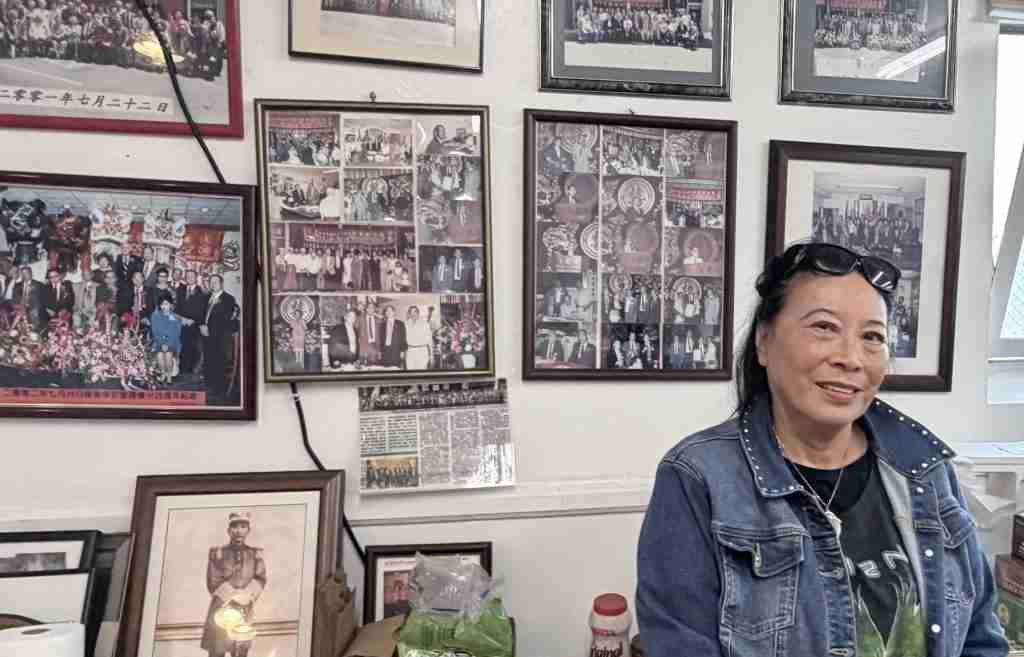
 Judi Wong at Bow On Association.
Judi Wong’s great-grandfather was one of the founders of Bow On Association, established in 1905.[3] In 1968, the Los Angeles Bow On Association 羅省岡州保安堂 purchased the San Pedro property, remodeled, and have their headquarters upstairs from Paul’s Kitchen restaurant. Judi’s family remains shareholders. Her father took a lot of photos for Bow On. She said, “I grew up in this East Adams area. My dad had the Texaco gas station, and I went to Chinese school with Dr. Lau and attended the Chinese Presbyterian.” Judi married LA County deputy marshal Henry Wong, one of the earliest Chinese American peace officers. Then 40, Henry was killed in 1989 while working security in Alhambra.
Henry’s family owned Nam’s Restaurant on Valley and Del Mar in the City of San Gabriel. Judi worked in telecommunications and as a buyer at the Sears “Cube” off Fremont in Alhambra, and helped out with the family’s restaurant at night. More recently, she is active with the Chinese American Museum, Chinese Historical Society, and the C.A.C.A. of San Gabriel Valley – giving back to the community. She is proud that her uncle and her father were honored with the Congressional Gold Medal for their military service in World War II. Coincidentally, she bought her first home in Monterey Park fifty years ago from Alan Yee – Paul Yee’s paper son.
Since February of 2026, the doors of Paul’s Kitchen have remained locked. But if only their walls could talk!
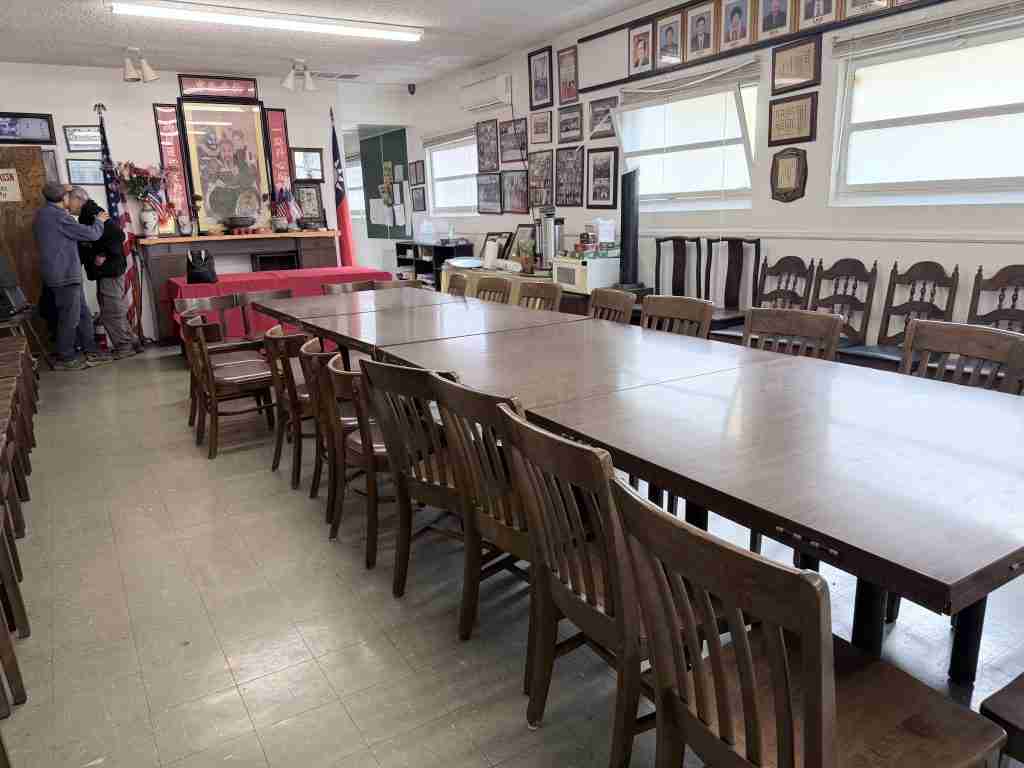
 Bow On Association Main Hall.
. 
Author’s note: Susie Ling is a member of the Chinese Historical Society of Southern California chssc.org.
——————————–
Thank you Susie for the great article on Paul’s Kitchen! My husband introduced me to it and we have been going for over 30 years. My favorite is curry tomato beef chow mein. We did see it was closed earlier this year a “closed, no workers” sign on the gate like someone noted on Facebook. But…..we were there last month and it is open!! They said they were closed for remodeling the kitchen. Thank you for all the history!!