
MOSF 20.15: On Bardos of Travel to Grenada; Sketches of Time (and Doing Time) on Planet Earth
Memoirs of a Superfan, Vol. 20.15: On Bardos of Travel to Grenada; Sketches of Time (and Doing Time) on Planet Earth
By Ravi Chandra
Written on JetBlue bardos between Grenada, New York, and San Francisco, November 12-13, 2025
Published November 16, 2025
A bardo is defined as a transitional, in-between state. Tibetan Buddhism defines three bardos in life (waking life, meditation, and dreaming), and three during death and before rebirth. This essay is about the bardos of my recent travels, my first impressions on traveling to the wonderful island of Grenada with the Black Psychiatrists of America in November, 2025.
“Metaphorically, bardo can be used to describe times when the usual way of life becomes suspended, as, for example, during a period of illness or during a meditation retreat. Such times can prove fruitful for spiritual progress because external constraints diminish.” Wikipedia

 black as a color is absolute, by Truong Tran
I. The Bardos of Beaches and Layovers
II. The Bardo of Mental Hospitals, and the needs they speak
III. The Bardo of our Human Migration in Time and Space
IV. The Bardo of the Prison, in which the Prisoner is Condemned Contaminant, a Microcosm of Colonial Trauma
V. The Caribbean as Colonial Bardo to American Empire
VI. The Delusional Bardo of Final Judgments
VII. The Beauty, Joy, and Ultimate Truth of Interdependence and Enlightenment

 Photo by Ravi Chandra, Grenada sunset
I. Bardos of Beaches and Layovers
To help my own mind re-weave the tapestry of real relationship from the ruptures of my and our past and present, I traveled to Grenada for the 2025 Transcultural Conference of the Black Psychiatrists of America. I was also invited to present on “the narrative of joy in the tale of many minds.”
The lasting impression of my week in Grenada will be the deep comfort and joy of being in a place where being richly, deeply melanated – being Black – was the norm. I fit right in. Melan-in. I experienced deep and sincere belonging with my Black psychiatrist friends and colleagues, and the friendly, hospitable citizens of Grenada, in a way that brought me back to my first experiences with truly diverse, brilliant, and experienced friends in college and medical school. I experienced no friction in mutual affection and appreciation, something which I frankly don’t find in most of my daily life in San Francisco. The local greeting is right hand over heart, eye meeting eye, with a warm smile on one’s face, reminding us that here, our relatedness was in the right place.

My colleagues and I “got” each other, when usually in my American life, there’s a feeling of being willfully “forgotten,” misunderstood, mislaid, or marginalized. The usual reserve, the “cottony avoidance” I’ve experienced in San Francisco and elsewhere, was non-existent. Perhaps, in America, the history of cotton, the great weight of the cotton industry, is in the psychic space between us, separating us from true, boundless, heart-to-heart, eye-to-eye appreciation. In Grenada, I felt palpably held, as if the attention of the island itself was on the warm space between us, in contrast to the American preening to be the apple of some eye in the sky, an eye which instead looks on us in judgment, not love. Or maybe that’s how my attention shifted, as I quickly relaxed into beach vacation mode. The island loved me, I think, in a way that the American nation does not, and perhaps will not and cannot.
But perhaps that is in part a reflection of my own ambivalence to America, which came into view as I approached TSA for my final leg home.

 “Thy will be done,” Grenada, 2025, by Ravi Chandra
Let’s double-click on that for a moment. On my way back from Grenada, I had an overnight layover at the TWA Hotel in JFK. The next morning, the morning of this writing, I was mildly cranky as I made my way to security to catch my flight back to SFO. At first, I attributed it to being underslept, hungry, and anxious about getting through TSA, but I realized that it was actually that I was transitioning from “relaxed” to “responsible,” and it was molecularlyuncomfortable. A visceral part of me was annoyed that I now had to serve somebody else, so different from the previous week, when I was getting served. Sigh. That sounds human enough. But I realized that my usual life of service in the States has the added burden of doing emotional labor for those who would rather be on their merry way, screwing the rest of us, on their way to screwing the starry skies. I am apparently tasked to pick the cotton out of the synapses of the collective psyche, in hopes that I might help the nation regain a responsible executive function.

 Who’s the tarmac daddy?

 A hallway in the Eero Saarinen designed TWA Hotel.
The great bales of historical transmission and cultural conversation are exactly what the powers-that-be want to ban on sight. The transmissions and conversations are that unsettling. To the settlers, shall we say.
America has a racial psychosis, a bizarre ambivalence and cruel split around intimacy with Blackness and Black identity, yet all races are interwoven and related, and are social and psychological constructs as well. “Whiteness” was manufactured in the American factory (ginned up in the cotton gin?) of strategic domination, influenced no doubt by experiences of subgroup subordination on the European continent, and in the end, a way to be “more British than the British,” while disavowing Britishness.
Theme song: “Yes we have no bananas! We have no bananas today!” No bananas at all.

The cruelties and contempts of Crown, Cross, Country, Court, and Cop have been visited on the Melanated, Minoritized, and Multiply Marginalized, all to maintain the tightest of the Tighty Whiteys “above” the revelations inherent in real relationship. BIPOC people have been subject to a Blatantly Ignorant Project of Contempt for centuries.

Such emotional labor requires beach vacation time for a whole lot of us.
II. The Bardo of Mental Hospitals, and the needs they speak
At about the midpoint of our four-day meeting, a group of us visited the island’s psychiatric hospital. There’s only hospital, and two psychiatrists, for a population of about 117,000. Up to 80 people, mostly men, are housed there at any given time, from a few hours up to … wait for it … decades. It was heartbreaking for me to see men, skinny and shabbily dressed, clearly hungry for all forms of nurture from physical to emotional, all of them isolated from the community with a fence topped with barbed wire, at least one of them behind barred windows in seclusion, not unlike the men I saw in the 7L “Jail Unit” of the San Francisco General Hospital.

I’ve often noted that patients hospitalized in the US for psychiatric reasons rarely get flowers or even visitors, and this seems even more true in Grenada. I didn’t see anything I would call an affront to human dignity or rights, as has been documented in many countries and in the recent history of the US as well, but certainly how a nation treats its vulnerable members, and indeed its own vulnerability, is a marker of anything we would call society itself. By my formulation, society is the sum of our love, and in the Americas at least, society and love are works in progress. Maybe this is true everywhere the sun shines, from the beaches of Point Selines in St. George’s, to the Appalachians, to San Francisco and Los Angeles, to the South Bronx and Manhattan, to Beijing, Rome, Kyiv, Capetown, Rio, Moscow, Mumbai, Beirut, Tel Aviv, Kenya, and Gaza.
May all beings be free of suffering and the causes of suffering.
May all beings know love.
May all beings know joy.
There are heroes in this struggle, and most of them are unsung. I met one of them, Dr. Evlyn Spencer, who has overseen the hospital for decades.

 Drs. Evlyn Spencer and Ravi Chandra (author)
I asked him at the end of our tour: “if you had three wishes to improve care at this hospital, what would you ask for?” In the back of my mind, I wondered if he would ask for the latest MRI, ECT, or TMS machine, or AI software…
He replied without hesitation, with only two requests of the universe: staffing for the hospital, and destigmatization of mental illness throughout the island.

 Back of Dr. Spencer’s shirt
There are moments that travel to your deepest core and all corners of the known universe. This was one of them.
He might as well have said, “Give me this lever and I’ll move the world.”
It’s what we all need in our travels and travails. People to accompany us, and people with understanding for the journey of being human. Of being, specifically, who we are. As Sting sings, “Take this space between us – and fill it up!”
Dr. Spencer, as you said to me when we took our leave of your hospital, “we are comrades.”
All of us, in psychiatry, mental health, the healing professions, and human services broadly speaking, are comrades. All of humanity could be this one great body of caring for itself, most intimately, most proximally, because we are “only ever us.”

This hospital was also the target of direct violence. The US bombed it during its invasion in 1983, supposedly mistaking it for a military outpost. 18 patients and staff were killed. People with mental health problems are the recipients of much violence, and this “failure of military intelligence” is another example of how the vulnerable are under threat from aggression. The invasion itself was supposedly to counter Cuban influence and a supposed threat to medical students, but functioned as a strategic maneuver and opening for commercial interests. However, islanders now honor all American, Cuban and Grenadian dead on the anniversary of the invasion, and there is a memorial to the dead at the hospital as well. Perhaps only in grief, in the aftermath of the violent transmission of history, can we find better paths forward, in the great body of caring that is “only ever us.”
III. The Bardo of our Human Migration in Time and Space
What keeps us from being this body? What keeps us, indeed…
Perhaps the steps we’ve taken from the cradle of our origin have changed some of our “us.” Yuval Noah Harari writes in Sapiens that the agricultural revolution made the ego of humanity (at least non-indigenous humanity) revolve around property, wealth, and status, instead of relationships. The withered branch from the forest of need-for-intimate-relationship has been grafted onto a tree straining upwards for attention, opulence, grandiose prominence, popularity, and thus “control,” as opposed to intimacy grounded in rootedness to community and place.
No wonder the world has gone mad. The crazy-tree, the tree of selfishness, factionalism, and greed, threatens to take the whole forest down.
Give us a lever…make us a lever from a branch of this undeniably powerful tree… and maybe we can heal this forest-world, this ocean-world, this island-world, this spaceship floating all alone in the deep dark sea, this beautiful orb that is only ever us.

Take the good and leave the bad.
American social psychiatrist Dr. Mindy Thompson Fullilove writes:
“My own work on the psychology of place sought to find the connection between massive destruction of community and shifts in individual and collective life. The psychology of place is an interdisciplinary field of study. I was able to draw on the work of scholars across geography, psychology, sociology, and anthropology to answer my questions. I identified three key psychological processes that were disrupted by upheaval. These are: orientation, place attachment, and place identity. If upheaval is not repaired, the rupture in these processes can produce disorientation, nostalgia (in the psychiatric sense), and alienation.
While Dr. (Wade) Nobles and Dr. (Rodrick) Wallace were writing about events in minority communities, medical geographers are clear that disturbances of health do not stay in one place, but spread via hierarchical diffusion, network diffusion and social contagion. We more commonly think of infectious diseases moving in this manner, however, psychological disturbance can also move quickly in human populations.”
Fullilove “adopted the term ‘root shock’ from gardeners in order to describe the ways in which people are stunned by upheaval.” (Maybe root shock would also describe the petit bouleversement (the mini-upheaval) in my re-entry to the US.) The word radical means connected to the root, and yet society fears “radicals” as threats, instead of welcoming them as messengers. We are uprooted, and can’t stand to be told about it.
Cue the playlist: “Yes, we have no bananas!” There’s nothing bananas about this place, no bananas at all…Trust me…now just put on this blindfold…

A major part of our upheaval is colonial trauma, leaving us the descendants of the enslaved, victimized, and genocided; those who enslaved, victimized, and genocided them; and those caught in and sideswiped by the tumult. All must decide what to do with the loathsome inheritance of abusive, corrupt power which remains a prominent influence and unforgettable imprint. Some opt to continue the abuse, to transmit it to others as if that would expel it from their camp; others adopt an ahistorical, present-centered approach to do the best they can to thrive in the moment; others are deeply burdened and affected by the trauma. My comrades, friends, colleagues, communities, and all the good-hearted do their best to transform the historical transmission in hopes of altering its horrific, all-consuming trajectory.
We are not all on the same emotional page, to say the least, but it would be nice to be on the same shelf, the same book, the same chapter, and even the same verse. It would be nice to get support for the lever we would make, out of the splinters it sometimes feels we are.
Like no
Culture before us, we relate the way the descendants
Of the raped relate to the descendants of their rapists.– Terrance Hayes, American Sonnets for my Past and Future Assassin
And truth be told, many of us have both “rapists” and “the raped” in our heritage. By relating to ourselves, we relate to the history of the world in us. This is a disturbing friendship, and the most intimate kind of necessary, good trouble we can imagine.

IV. The Bardo of the Prison, in which the Prisoner is Condemned Contaminant, a Microcosm of Colonial Trauma
I was moved by an anecdotal account of prisoners in Grenada being fearful of what they consumed, some of them mired in their own excrement. Apparently, some prisoners refuse food (which is prepared by other inmates), fearing it is poisoned. They become malnourished. The mentally ill amongst them also have particular problems with their own sanitation. These are tragic conditions of squalor and neglect, but also the concrete manifestations of how colonialism lands on our modern world: we are fearful, even paranoid, about what we are being “fed,” and we are mired in psychological waste products.
Trump is reportedly actually incontinent of stool, and yet he posts AI videos of himself dropping feces on protestors.

How different is President Donald Trump from a prisoner smearing feces on his cell wall, and calling it “humorous art?” Prisoner Number 1 is smearing his Number 2 on other humans, though, and wants to be celebrated for it.

The ill prisoners and Trump find metaphoric parallel in the Hindu caste system as well, in which so-called “untouchables” are assigned to clean the latrines of the anointed “higher castes.” What seems like order is actually mandated dissociation, dissociated self, dissociated executive function, and dissociated and delusional rationales. Some part of “us” claims “cleanliness” (proverbially next to “godliness”) while uncleanliness is projected into “others”: “heathens,” outcastes, outsiders, or migrants whom Trump calls “dirty” and “vermin.” Asians were considered unclean throughout American history, most recently during COVID-19 pandemic, by people who could only see threat in person-, people- or community-sizes, and not virus- or neuronal-bias-size.

 Adobe stock photo licensed by Ravi Chandra
When I was four, a white boy in Alabama told me my brown skin was “dirty.” I went home and scrubbed with Ajax. When my mom got home, all she said was “that will not go.” She had no awareness of racism then. I received no explanation for this clouded perception of my South Asian melanation. Instead I received the culture’s psychological condemnation, which was repeated in sad, solemn, silent, internal, Asian American, self-negations. Awaiting invocation; innovation; transformation; ascension.
I’m reminded that mental health was once called “mental hygiene.” “Sane,” “sanitorium,” and “sanitary” are all derived from Latin “sanitas.”

 Adobe stock photo by LIGHTFIELD STUDIOS, licensed by Ravi Chandra
Compare to wellness, a word related to wholeness. Being well and whole implies an inner and outer integration; deconstructing the tendency to deny or discard one’s own undesired qualities into others, who are ultimately part of the greater whole to which we all belong.
Gandhi’s communities sought to get everyone on the same emotional page, in part by having everyone clean toilets.
Everyone poops. All adults clean their own bottoms, until they are incapable and need to lean on someone else’s help. Nearly all parents clean their infant’s waste, and most humans are quite capable of cleaning their own toilets, The Earth calmly takes all our poop. I don’t know that I’ve heard her complain on this matter; her microbes, beetles, and other organisms probably clamor for more fecal sustenance! It’s just we who get sick on waste, and thus need to be mindful of how we treat it, and how we treat each other.
Can we get on the same emotional page about these “unmentionables?”

V. The Caribbean as Colonial Bardo to American Empire
The Caribbean played a central role in the British Empire, especially before it turned its attention to South Asia, leaving its American prospects to those who claimed victory over tyranny, touting Enlightenment values even as they perpetuated their own tyrannies, on all who were not wealthy white males. The settler-colonizers fattened themselves on Caribbean sugar and rum trades (the Puritans were not pure on these scores), and expanded chattel slavery to bottomless lows that scarred the entire Americas. And they harvested not just rum and sugar from the Caribbean, but also means of control.

Roxane Dunbar-Ortiz writes in Loaded: A Disarming History of the Second Amendment:
“Because chattel slavery was uncommon in the 1500s in England itself, the existing legal system that colonists brought to the early British colonies in North America did not suffice, so nearly all law related to slavery was forged in the colonies, borrowing from existing practices in Spanish, Portuguese, and English Caribbean plantation colonies, and specifically borrowing the use of slave patrols from the Caribbean and adapting them to local conditions on the continent.”
Slave patrols in the Caribbean became slave patrols (“paddy rollers”) in the US, then the KKK (through men like Nathan Bedford Forrest, Confederate Cavalry Officer responsible for the massacre of hundreds of Black Union soldiers in 1864, a war crime for which he was pardoned by President Andrew Johnson in 1868) and then the LAPD (through William Parker, Chief from 1950 through the Watts Uprising in 1965, who specifically recruited Anglo veterans from the South and Southwest to create “the most notorious racist police operation (“police culture”) in the country, with nearly every aspect of the Southern (read imported Caribbean colonial) tradition of slave patrols woven into the system” per Dunbar-Ortiz.
Again, history is not necessarily deterministic, but we must grapple with disturbing origins and a painful present to set our futures right.

 Drs. Rahn Bailey and Ravi Chandra
VI. The Delusional Bardo of Final Judgment
We were given an introduction to the evolution the Grenadian criminal justice system and ongoing reform movements. Flogging and collaring were practiced in the British Empire, and even more severely on enslaved populations in the Caribbean. Grenada, following independence in 1974, still utilized flogging, and criminalized even minor “infractions” like using offensive language and flying kites. Jamaica abolished corporal punishment only in 2013, and Grenada didn’t ban flogging as a punishment until October, 2024. Suicidal actions are still criminalized in Grenada, though these laws are not enforced. Gay rights have advanced in recent years in Barbados, Saint Kitts and Nevis, and Antigua, but anti-LGBTQ laws remain on the books in Grenada.
I asked the speakers about the rigidities of tight behavioral and identity control. They replied with the line I used above: the former colonies could be “more British than the British.” What the British did to the Colonies, the formerly Colonized and Enslaved then did to themselves. The Old Country moved forward in significant ways, but their most crude, cruel, and primitive ways were preserved, in Caribbean and American criminal justice and law enforcement systems, but also in the ways we look at each other.

 Photo by Ravi Chandra
Obscuring and deluding our gaze: Chattel slavery, Colonialism, Cotton, Cross, Crown, Country, Court, and Cop, all attempts to be on top, and to one-down the Melanated, Minoritized, and Multiply Marginalized. If you’re Black, stay back. If you’re Brown, stay down. If you’re Queer, clear outta here.
But there are those of us who took their one-down, and rooted ourselves instead.
It is not we who are wrong, but your minds that have framed us as other, and lacking. We are in your blind spot, and you are aggressive towards what you can’t see, or understand. Don’t worry; we all need “I” exams in life.

 “Your living water flow over my soul…” Grenada 2025 photo by Ravi Chandra
VII. The Beauty, Joy, and Ultimate Truth of Interdependence and Enlightenment
There are those who wish to impose final judgments on others they deem contemptible. Their delusion is that this will separate them from a messy reality of relatedness.
But the truth is that a simple turn towards each other, towards the Earth, could change everything.
My friend’s daughter, when she was a child, had a friend who feared gravity. My friend’s daughter said, simply, “gravity is just the Earth trying to give you a hug.”
What a generous, gentle, and powerful hug I felt in Grenada, from my colleagues, Grenadians, and the mother who sometimes does not know her own strength. She can hug us so hard we go splat.
We children take her hug for granted, though. We are only ever us, but an all-too-amnestic us.
Maybe she is hugging our heads together with all her might, to create a functional Geocortex, to think ourselves together, and not think ourselves apart.
Give us a lever. Simple asks: staffing and destigmatization.
I promise you, we will deliver a celebration, of our cause for compassion, understanding, reason, and relation.
Happy Bardo to ya! Happy Bardo! Happy Bardo!

For further reading and viewing:
Kim F. Hall: The Sweet Taste of Empire
https://www.youtube.com/live/a-Npxq-A8mM?si=mhqjFXHXC3blQroy
Chandra R. MOSF 17.12: America, Under the Spells of Contempt and Idealization. East Wind eZine, October 7, 2022
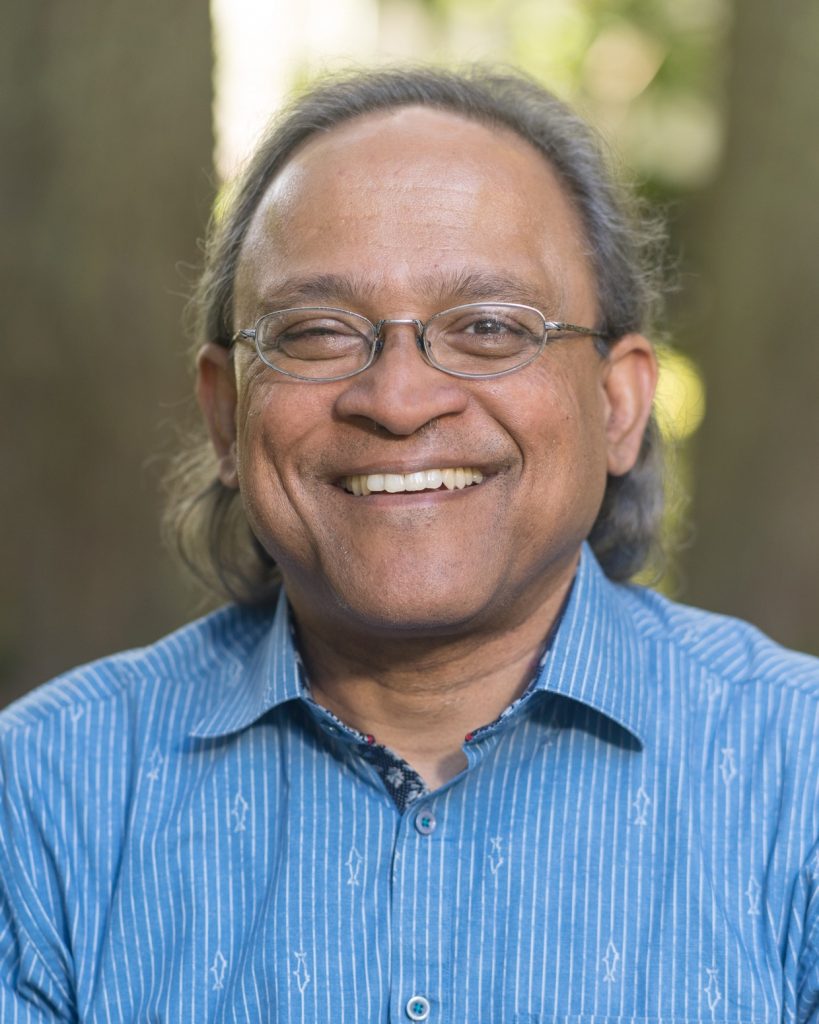
 Photo by Bob Hsiang, 2022
Ravi Chandra is a psychiatrist, writer, compassion educator, and civilizational health shaman in San Francisco, and a Distinguished Fellow of the American Psychiatric Association. He is the recipient of the 2025 Kun-Po Soo Award for Achievement in Asian American Psychiatry from the APA and APA Foundation. Here’s his linktree. Please sign up for East Wind and Psychology Today updates via Substack where you can also support his educational and creative mission by becoming a free, paid or founding subscriber. For fourteen years, he was lucky to have his MOSF posts published by the Center for Asian American Media, and is now at work broadening and building a diverse creative community and coalition through reflecting on culture and psychology for East Wind eZine. Sign up for updates here, and see all the posts here. He writes from the metaphorical intersection of The Fillmore and Japantown in San Francisco, where Black and Asian communities have mingled since the end of the incarceration of Japanese Americans during World War II. He literally works there, between two Indian restaurants, go figure. His debut documentary was named Best Film (Festival Director’s Award) at the 2021 Cannes Independent Film Festival. The Bandaged Place: From AIDS to COVID and Racial Justice is available on-demand, and with the discount code “Awake” you can get a 20% discount. His nonfiction debut, Facebuddha: Transcendence in the Age of Social Networks, won the 2017 Nautilus Silver Award for Religion/Spirituality of Eastern Thought. You can find him on Psychology Today, Medium, Twitter, Threads, Facebook, Instagram, YouTube, TikTok, SoundCloud, or better yet, in the IRL.