
MOSF 20.10: Satsuki Ina’s “The Poet and the Silk Girl” Vividly Portrays Japanese American Imprisonment, Intergenerational Trauma, and Healing – Through Her Family’s Story
Memoirs of a Superfan, Vol. 20.10: Satsuki Ina’s “The Poet and the Silk Girl” Vividly Portrays Japanese American Imprisonment, Intergenerational Trauma, and Healing – Through Her Family’s Story
By Ravi Chandra
August 5, 2025

For news coverage of recent anti-ICE protest in Dublin, California, see my Substack and YouTube playlist. Also see Dr. Satsuki Ina’s website for more of her work.
San Francisco, 1939. The poet, Itaru Ina, was a soulful, deep, handsome young man gifted with a romantic imagination. The silk girl, Shizuko Mitsui, was a bright-eyed, sweet, effervescent young woman, returning to the United States to represent Japan’s silk industry at the Golden Gate International Exposition (World’s Fair) on Treasure Island in San Francisco. She needed her watch repaired. Accompanied by a chaperone, she visited a watchmaker in Japantown. The watchmaker, soon to be matchmaker, invited her back for dinner. The poet had become his surrogate son since his father, ill, had to go back to Japan seven years earlier. The poet and the silk girl began to fall in love, with the sound of ticking clocks and swinging pendulums in the background, metronomic reminders of heartbeats and heartaches held in a watchful time, past, present and future. Just over two years later, Japan would bomb Pearl Harbor, FDR would sign EO 9066, and the poet and the silk girl, US citizens by birthright, now married, would be incarcerated in America’s prison camps. The poet would become a protestor, then punished with imprisonment and separation from his wife and two young children. The family would be marked for deportation and labeled “alien residents,” until, at long last, a determined lawyer from the ACLU demanded justice, and the government relented, mostly because further persecution would be too expensive. Their citizenship would not be restored until 1959, 14 years after it had been taken away under the duress of war and their betrayal by the government of their country of birth.

80 years after that fateful meeting, the two oldest children of the poet and silk girl, Kiyoshi and Satsuki, both born “doing time” in America’s World War 2 era concentration camps for Japanese Americans, would sit in a healing circle with Latine migrants recently released from detention in Laredo, Texas, awaiting their hearings. The children, now elders themselves, offered their stories, the stories of their parents, and encouragement. One of the migrants replied, “I have just spent four months in a terrible place. I feared for my children. We were hungry and afraid every day. When I hear that you were in prison for years, my heart aches for you. I cannot imagine your suffering.” Satsuki writes, “It was an incredible moment of connection. She was crying for us. Her empathy knew no bounds. I had never felt so seen. An ocean of love seemed to fill the room as we sat side by side, quietly letting the tears flow. We were crying for them. We were crying for ourselves…We came wanting to offer help, yet we were the ones who received the most profound gift.”

The journey of a century comes full circle, or spiral, in Satsuki Ina’s moving biography of her parents and glimpse of her own career, The Poet and the Silk Girl: A Memoir of Love, Imprisonment, and Protest. Ina became a psychologist, filmmaker, and activist to bear witness and bring healing to the wounds of Japanese Americans and other victims of abusive power and state violence, but the lives of her parents take center stage in this narrative, conveyed primarily through their translated letters and diary entries from the time of their meeting through their incarceration and imprisonment. Their growing love for each other; their eagerness to see each other and begin their lives together; their fears as war broke out; and their anxieties and angers as they were separated and the government revoked their citizenship, determined to deport them and their children. Their love and youthful exuberance were an antidote to the losses and deprivations they had already suffered in childhood, but what could have been joyful growth out of those early losses met the unrelenting, fulminant expression of their nation’s longstanding racial psychosis which saw them only as threats and second-class subjects, marked for discrimination, scapegoating, and potential elimination.
How does consciousness and community grow from such painful ordeal? How to bring depth to identities flattened by the stereotyping and othering of the majority culture?

 Itaru Ina with his Rolleiflex, 1939
Another Japanese American psychologist, Lisa Nakamura, once told me that “Japanese American (and Asian American) identity formation is complex.” In large part this is because of our ambivalent, ambiguous, and fragmented relationship with one another and with a culture complicit with extraordinary harm yet tantalizingly capable of enormous uplift and possibility. Each meeting sways on this agonizing spectrum of trust and futility, hope and despair, dream and doom. How do you live with a beast that might smile at you, before all-too-easily turning to devalue and devour you? A beast that gives examples of its conquests every day, racking up victims, even as we try to find and make relief? The beast is a brutal companion to our lifelong quest for safety, accomplishment, and even love, leaving its mark in our psyches that vacillate between connection, presence, and promise, and alienation, isolation, and torment. Doesn’t the beast sit hidden deep behind the eyes of initially welcoming individuals and institutions? If you know, you know. Those of us who aren’t completely lost to this fire might perhaps gain what I’ve called an Asian American han, a felt sense of shared oppression (to borrow a term from Korea), part of the broader han of all minoritized and subordinated people, itself a subset of the suffering caused by tyranny and abusive power, the suffering we ache to transcend through our own empowerment, voice, and agency.
If you name it, you can tame it. If you feel it, you can heal it.

 Kiyoshi and Satsuki Ina one year after release, Cincinnati, Ohio, 1947.
Satsuki Ina names the intergenerational trauma she has helped decode in over four decades of work, and in her award-winning documentaries, Children of the Camps and From a Silk Cocoon (available on Kanopy and Prime). She writes of “long-term psychological consequences resulting from deprivation, loss of agency, and humiliation that endure for decades, even generations, after the trauma was first inflicted,” and the internalization of the narrative of the perpetrator, which displaces the true self. The victim becomes only what the perpetrator wants: silent, obedient, and still, hated and at risk for harm.
“For Japanese Americans, many of the coping strategies adopted during imprisonment were in sync and intertwined with Japanese cultural values such as stoicism, conformity, conflict avoidance, and respect for authority, which made those strategies more deeply entrenched and difficult to recognize. Children of trauma victims often grow up observing and absorbing the silence. The shadow of secrecy and shame follows the trauma of unrelenting humiliation.”
But “just as my parents had experienced a renewed sense of dignity when they chose to protest their incarceration, seventy-five years later we felt purpose burn through our cloak of compliance, conflict avoidance, and silence—symptoms of our own trauma.”

 Itaru and Shizuko Ina in mugshots taken during their incarceration.
One of my greatest misgivings as a psychiatrist is that I was not introduced to Dr. Ina’s films and other work until well after I finished my residency. She befriended me, welcomed me into her fold of compassionate co-conspirators, and trained me to facilitate Healing Circles for Change with Tsuru for Solidarity, the social justice organization she co-founded in 2019. Satsuki was the surprisingly the first person to recommend to me Judith Herman’s seminal work, Trauma and Recovery. Dr. Herman revealed the finding that the pair bond was a predictor of survival in Holocaust research. The unit of survival is we. The more we think of each other as part of a “we,” the more we can live, grow, adapt and survive.

 Satsuki Ina, Ph.D.
Satsuki taught me her favorite way to respond to “how are you?” at a summit on healing intergenerational trauma last year.
Okagesama de. “In your shadow,” or “thanks to you.”
(For more news coverage, see my Substack and YouTube playlist.)
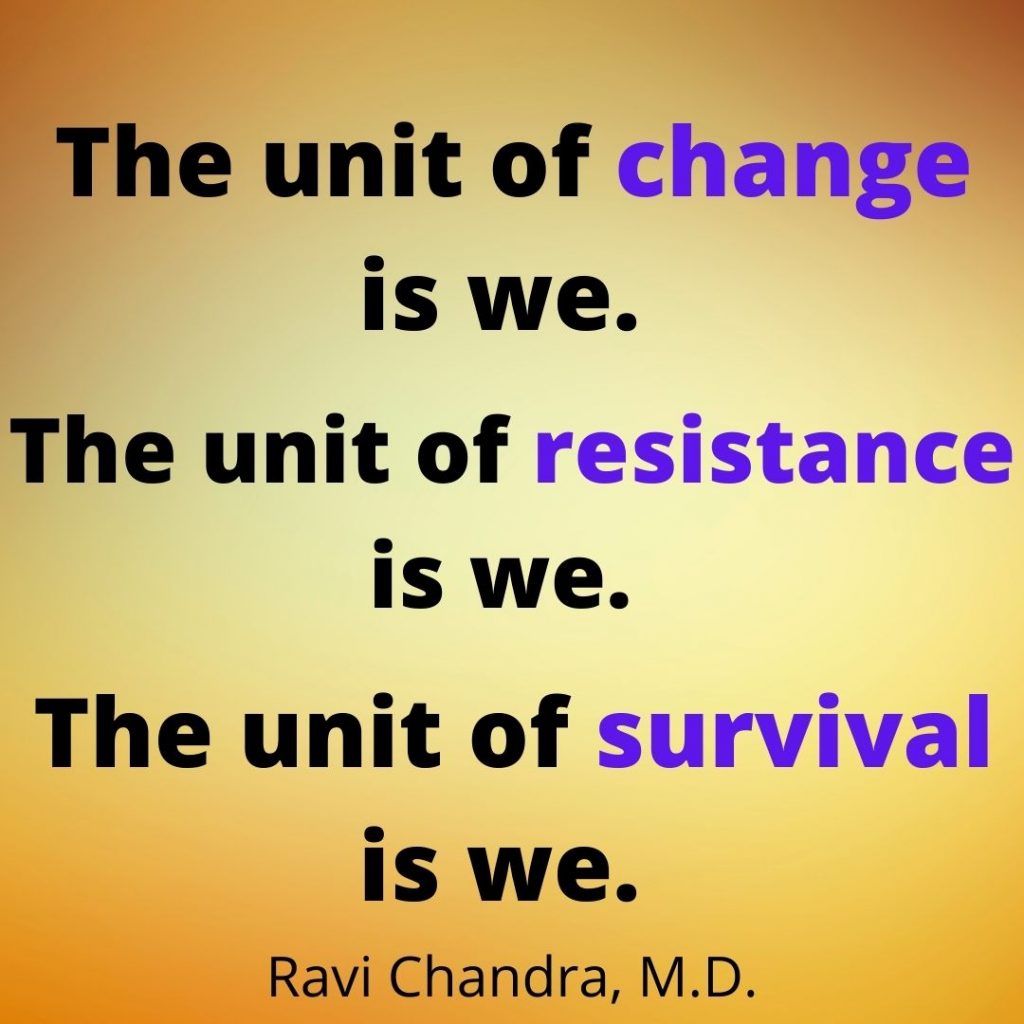
We find our true selves in our interdependence, though we live in a nation trying to rip us from it, dehumanizing us and defacing its own ideals in the process. Transforming this reality with resistance, insight, and allyship is our only path out of deadly repetition compulsion.
Ina’s book and life work boundlessly grow the possibility that even now, we can become compassionate allies to the vulnerable and our own vulnerability and trauma, and together, create a “we” that can heal, live, and even thrive. Diverse, and proud of our diversity, rather than in anguish because of it.
May her parents, the poet and the silk girl, be proud of the work we all do together, carried by the waves of healing she, and they, have inspired.

 Author with renowned psychologist and activist Dr. Satsuki Ina. Photo by Ravi Chandra, anti-ICE protest in Dublin, California, July 19, 2025.
For further reading:
Kariisa J. ‘The Poet and the Silk Girl’: A Japanese American Story of Love, Imprisonment and Protest. KQED, March 15, 2024
Hennessy-Fiske M, Carcamo C. ‘What happened in World War II is happening again’: Immigrant detention centers through the eyes of a therapist. Los Angeles Times, April 11, 2016
Chandra R. Dr. Satsuki Ina on Migrant Detention, Racism and COVID19. Psychology Today, April 6, 2020.
Chandra R. Dr. Satsuki Ina on Japanese American Trauma and Healing. Psychology Today, September 26, 2023.
Chandra R. Memoirs of a Superfan Volume 13.11: Umami, “Jimami Tofu” and “Aunt Lily’s Flowerbook” CAAMedia blog, May 31, 2018

 Photo by Bob Hsiang, 2022
I lost my we and keep looking for it. Or perhaps I have found it too many places,too many lost friends.