
MOSF 19.19: Taking Stock – Engaging Our Ongoing Psycho-Spiritual-Historical-Electoral Struggle with Joy and Clarity
Memoirs of a Superfan, Vol. 19.19: Taking Stock – Engaging Our Ongoing Psycho-Spiritual-Historical-Electoral Struggle with Joy and Clarity
By Ravi Chandra
October 29, 2024
Let’s start with the positive. In every disaster, real and imagined, a dystopian scene presents itself, but invariably, people come together to make a difference. A new society is formed in the rubble. Sometimes it is short-lived, and other times it makes a lasting impact in the life of the people involved, and even the world.
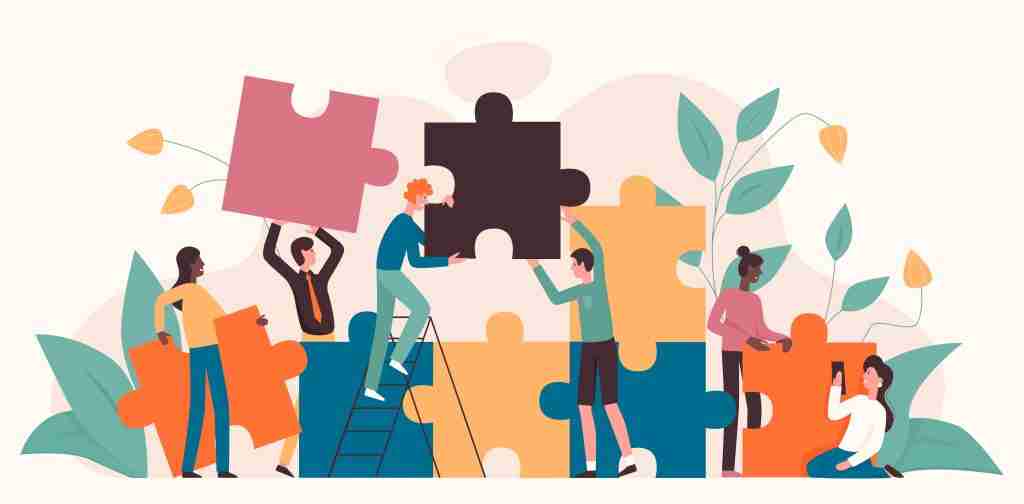
 Adobe stock image by Flash Vector, licensed by Ravi Chandra
We are in the hands of destruction and creation, and creation will win. We can choose the better story of our lives together, and I think we will.
Rebecca Solnit’s A Paradise Built in Hell has been on my reading list for years, but alas, I have not yet gotten to it. Sorry, Rebecca. Soon, I hope. From the description:
“The most startling thing about disasters, according to award-winning author Rebecca Solnit, is not merely that so many people rise to the occasion, but that they do so with joy. That joy reveals an ordinarily unmet yearning for community, purposefulness, and meaningful work that disaster often provides. A Paradise Built in Hell is an investigation of the moments of altruism, resourcefulness, and generosity that arise amid disaster’s grief and disruption and considers their implications for everyday life. It points to a new vision of what society could become – one that is less authoritarian and fearful, more collaborative and local.”
The hell that we are facing is quite clear to anyone concerned about democracy, and the threats of demagogues and exploitation. Why has the media layer, the GOP, and a huge fraction of our population discounted experts who have been sounding alarm bells about Trump and his cabal since 2015?
There were those of us who saw him as a threat and a dysfunctional human being even as he descended that escalator to deliver his hate-filled 2016 campaign opener at Trump Tower. He has shoved, lied, cheated, and seduced his way into our commons. He has taken up arrogant room in our minds, a “psychic berserker” as I called him in MOSF 19.11 (The People and Harris v. An Increasingly Unhinged Trump). But others viewed him as a Great Disrupter who would take his ugly, resentful, personal-cum-factional-but-always-personal fight to the global stage, thereby challenging the strength of the systems that have governed us. Some felt he would tear the scab off the wound of White Supremacy by amplifying it.
You can’t fight it til you see it. Some may say we have seen too late, but we stand on the shoulders of giants who have seen this since the beginning. Respect and heed our American prophets, all of them founders of the conscience and constitution of the nation. More on one a little later in this essay.

 Adobe stock image by Love the wind, licensed by Ravi Chandra
The unwelcome challenge must be accepted. Instead of meeting their dogmas with only our own assertions, I suggest we all carry questions that our “warring mind states” are trying to resolve.
Questions like: What is the role of the individual and the collective? What is society? What are healthy and dangerous influences? How should systems work? How could these even begin to work without the commitment of individuals to integrity, shared humanity, reason, and compassion? How could they work without being challenged to work better? How do we rise, individually and as a nation, to face disruption and disrupters?
I think we should start by not giving cruelty purchase on our consciousness, and by recognizing it has been part of what has formed us.
We are a reluctant family, a happenstance family, brought together by forces, cruel and noble, deceitful and true. We stand, adorned with beauty, progress and growth, and haunted by a past that is always present, an ugliness that rears its head whenever we look hard in our mirror. But look we must. We must bring love and radical acceptance to who we are, now. Psychologist Carl Rogers said, “The curious paradox is that when I accept myself just as I am, then I can change.”
America, please accept that racism has poisoned your blood. Not immigrants. Not anyone who critiques abusive power. America, please look in the mirror. As I radically accept the vehemence and vitriol of your racism, I also know that you and we are more than that. Only by working together towards mutually shared goals can we overcome our cultural, conscious, and unconscious biases.
 Adobe stock image by pisan, licensed by Ravi Chandra
This struggle is not futile. This struggle makes us who we are.
America, allow us to be works in your progress. We are here to illuminate, nurture, and heal, not destroy.
“There is good in you. I have felt it.”
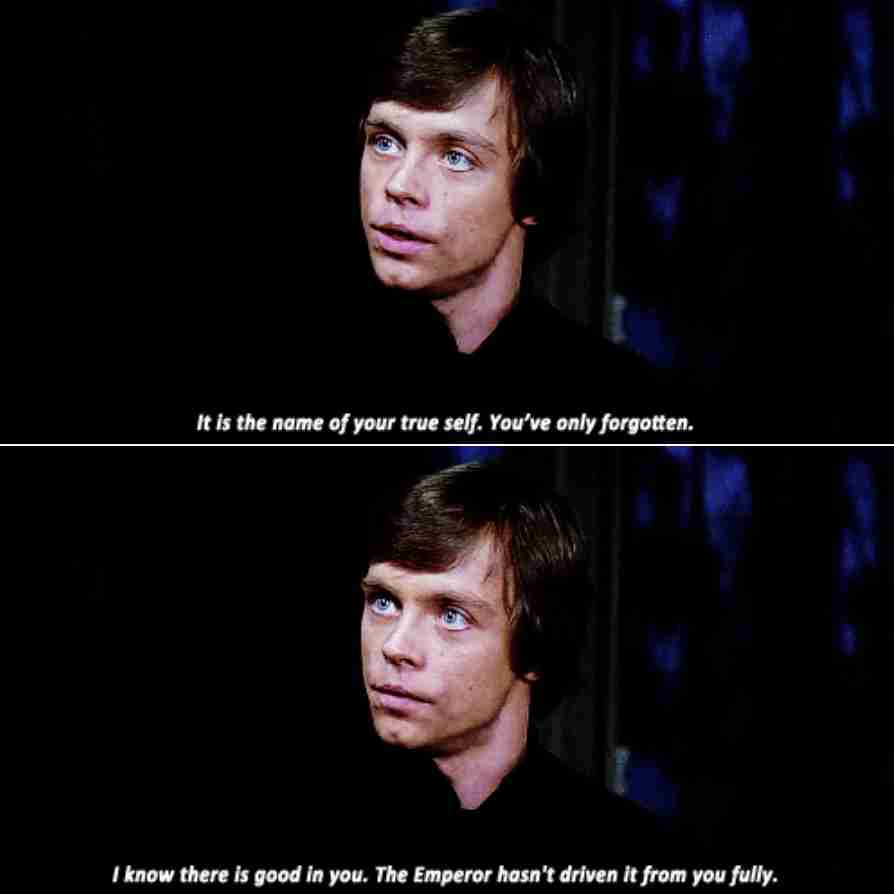
(There is good in America. But is there good in Trump? Maybe – but not enough good to be in charge of the country.)
I have never felt more confident about an election in my lifetime than I do about this one. (Well, maybe 2012.) Though I am disturbed by what this struggle has revealed about America and the human mind, I am confident that we are “going forward, and not back” as Kamala Harris has proclaimed. We have learned, and we are not going back to the house of the abuser.
Trump’s win in 2016 killed many of us, from Muslim Bans to COVID to Anti-Asian Hate and Charlottesville, but it also propelled us.
We define ourselves by contrast.
Here is The New Republic’s list of “The 100 Worst Things Trump Has Done Since Descending That Escalator” (October 21, 2024). At 100, we have “Shark or Electrocution: The Eternal Debate”, “a nostalgic way to ease our way into one man’s addlepated corruption, while leaving us a lot of room to build up to other, much worse things.” TNR has his anti-Haitian rhetoric only at #64, while his comments on Charlottesville are at #13 and the Muslim Ban is at #5. At #1 is January 6, 2021, followed by his pandemic response and his SCOTUS deformation. Every day of his presidency was a chaotic horror that you cannot make sense of without recognizing the pathology and twisted pain of the man himself, a gleaming orange shell of bluster, braggadocio, and bullshit, a bold, hypermasculine shell covering admiration and emulation for he who moved masses to murder, and strongmen whom he flatters and from whom he seeks love, as if they were his father.
We define ourselves by contrast.
We meet pathology with our health.
The antigen triggers an immune response. (And by antigen, I don’t really mean Trump himself, but all the ways that selfishness, abuse, and exploitation break love, compassion, reason, and egalitarian relations; the immune response is in creating belonging.)
We define ourselves by affirmation.

 Adobe stock image by Elena, licensed by Ravi Chandra
As an exercise we could begin listing the 100+ best things we have done, individually and collectively, since the escalator, to oppose Trump specifically, to affirm who we are, and create a culture of insight, friendship, kindness, kinship, and compassion, beyond the toxicity of exploitation and abuse. Each of us has done something every single day that proves our humanity and creates connection. If there are those who haven’t – well, you’re works in our progress too.
Trump’s threat has not faded, but we are strong. There will be well over 80 million votes for Kamala and Tim counted in this election, and I think well over 85 million. We can appreciate and be grateful for each other.
Every last one of us could write a book, if not an encyclopedia, about Trump’s damages and damaging ways. Every one of those voters has a story about why this dude is totally unacceptable as a putative “leader of the free world.”Leader of the Fry World, sure. Lord of the Fries, ok. But not president of the motha-blankin’ UNITED STATES OF AMERICA! He should not be in a position to proclaim “Arbeit Macht Fry.” (OK, I know that one may have tipped into deeply unacceptable territory, but humor, even dark humor, has been one of our best weapons to point out the sick absurdity of this man and his broken brain that tragically mirrors and weaponizes our own brokenness.)
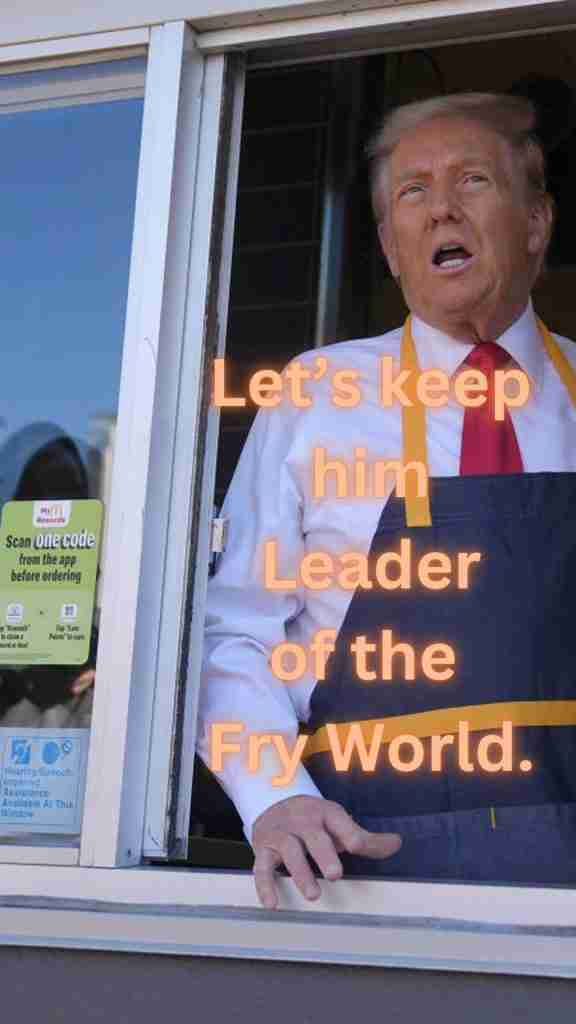
Let’s not forget who we are.
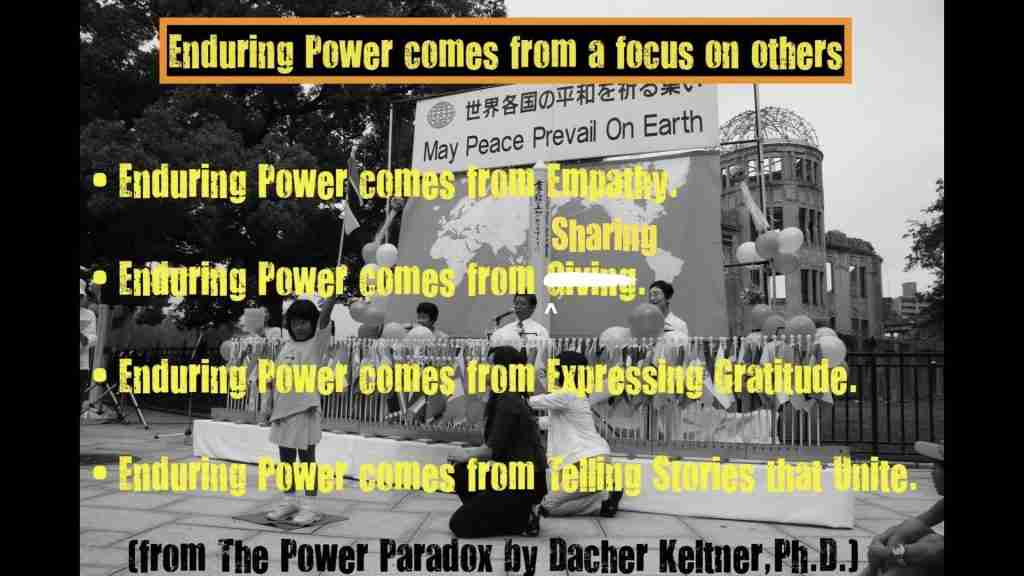
We are capable of self-reflection, accountability, apology and repair – all parts of “enduring power” – a term coined by UC Berkeley Social Psychologist Dacher Keltner and modified by me. I outlined it in a Psychology Today article in 2022, and before that in several presentations.
“Enduring power, [Keltner] writes “comes from a focus on others.” Embodying and supporting this kind of power alleviates suffering and creates the conditions for belonging.
Enduring power comes from empathy.
Enduring power comes from giving. (I would modify this to “sharing.”)
Enduring power comes from expressing gratitude.
Enduring power comes from telling stories that unite.
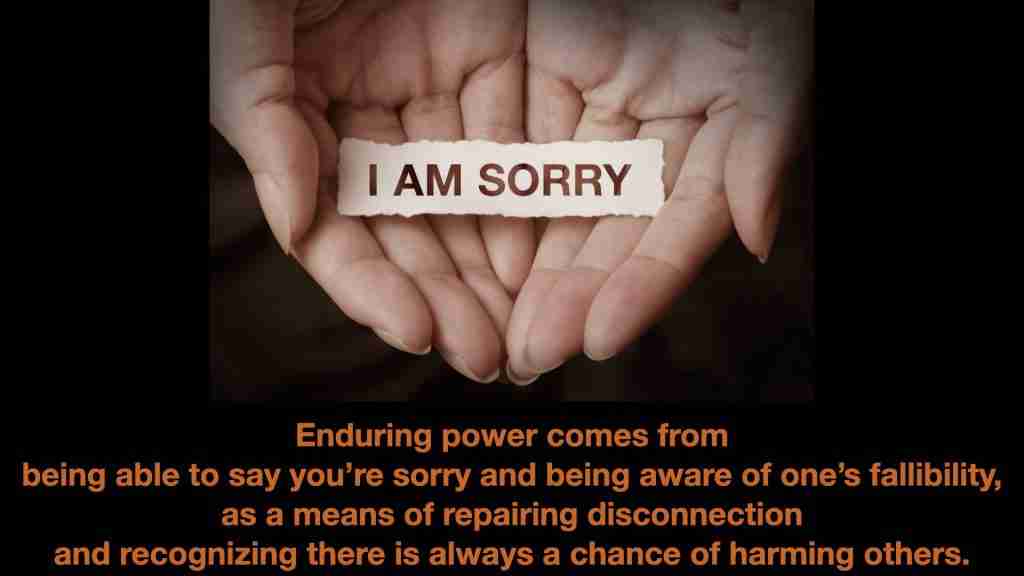
To Keltner’s list, I would add a fifth quality of enduring power:
Enduring power demonstrates the ability to apologize and make amends. Enduring power remains humble, and knows that it is possible to err and harm others, because we all operate from our own perspectives and can misunderstand others and devalue their needs in favor of our own. (For more on humility, see my last post.)”
Now, I don’t mean to sound self-righteous. I have a seed of compassion for Trump. I recognize he is human, and a recipient of horrific parental abuse that drove his brother to drink and eventually killed him. I recognize that abuse propagated in him, and he transmits toxicity to us. I recognize he is likely a deeply unhappy man, who may also be in the throes of cognitive decline.
He is just human – vulnerable, frail, imperfect – just like me.
I recognize that I am not now and have not in the past been beyond selfishness. I can remember moments I’ve been cruel to others, or participated in cruelty. I recognize I have hated Trump like I’ve hated no person before, but I recognize in my hate the unmet needs for care I and we all carry.
But I don’t want to carry forward the trauma inflicted by Donald Trump’s father, or the culture that produced and inflated Donald Trump. I want to transform it, and see where that takes us.
I recognize in this moment Universal Human Transmissions of our shared humanity, the common emotions of feeling unprotected, deprived, and betrayed.
 Adobe stock image by Pictandra, licensed by Ravi Chandra
But I also know my life has tended towards community and caring for others. I recognize that part of being a grown up is caring for these UHT’s within myself, and providing protection, nurture, and allyship for other vulnerable people.
One of the greatest joys of adulthood is in feeding the ones you love. Feeding a hungry stranger. Contributing to the network of nurture. Many of us feel like we give more than we receive, at least in some moments. But “ask not what your country can do for you – ask what you can do for your country.” Society keeps the score.
It never quite feels like enough, does it? But in that way, perhaps I mirror America too.
I, too, sing America. The America of self-reflection and doing better than we’ve done. The America engaged in a psycho-spiritual-historical and electoral struggle to prove itself; to live.
Alexander Hamilton marked what could kill us from the beginning:
“When a man unprincipled in private life desperate in his fortune, bold in his temper, possessed of considerable talents, having the advantage of military habits—despotic in his ordinary demeanour—known to have scoffed in private at the principles of liberty—when such a man is seen to mount the hobby horse of popularity—to join in the cry of danger to liberty—to take every opportunity of embarrassing the General Government & bringing it under suspicion—to flatter and fall in with all the nonsense of the zealots of the day—It may justly be suspected that his object is to throw things into confusion that he may “ride the storm and direct the whirlwind…
No popular Government was ever without its Catalines & its Cæsars. These are its true enemies.”
The ”enemy within” is everything in us that gives Trumpism a leg up. Every bias that dittoes his. Every cruelty we inflict on others. Every bye we give to exploitation and abuse. Every way we are groomed and conditioned to act like him, to give him a pass, to dismiss the charges against him, to devalue ourselves in his favor.
He is the cruelty most have been unconscious of.
Freud wrote “The unconscious can only be known after it has undergone transformation or translation into something conscious.”
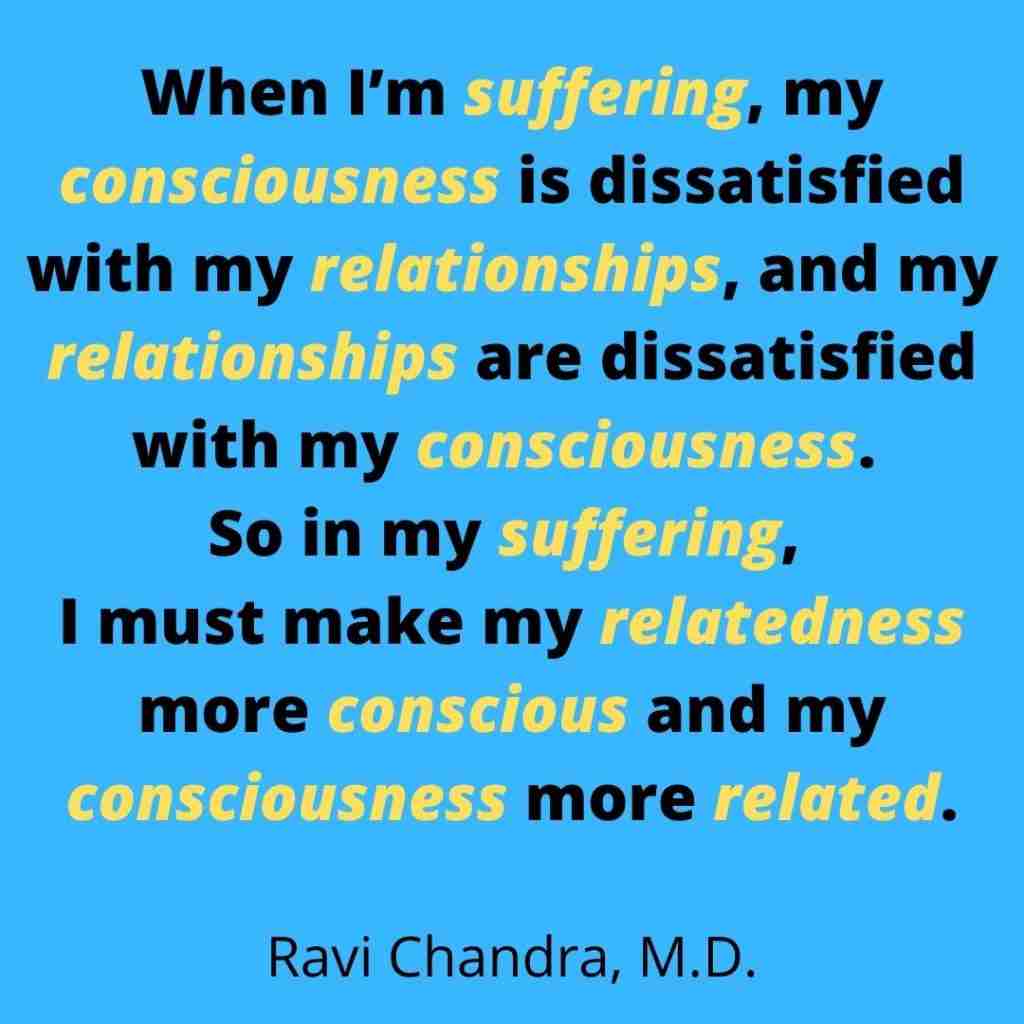
I wrote:
“Perhaps what we are most painfully unconscious of is our very relatedness. Our relatedness has not been brought into anything approaching ease. Instead it is a source of conflict – joy and torment, safety and anguish, war and peace. We are also unconscious of how our distresses are connected, and communicate, without our awareness or consent.”
In this disaster, this “paradise built in hell,” we are growing more conscious. We are paying more attention to our relatedness and the ways we suffer from cruelty. This is a payoff in itself.
The last poll by ABC/Ipsos had Harris up by 4 nationally. She was up 14 (FOURTEEN!) among women, and down by 8 with men. I like those odds. I think she’ll do even better next week.
I’m sending a message of compassion back, to myself in younger years, to all those who have struggled over centuries.
We are what democracy looks like.
Joy.
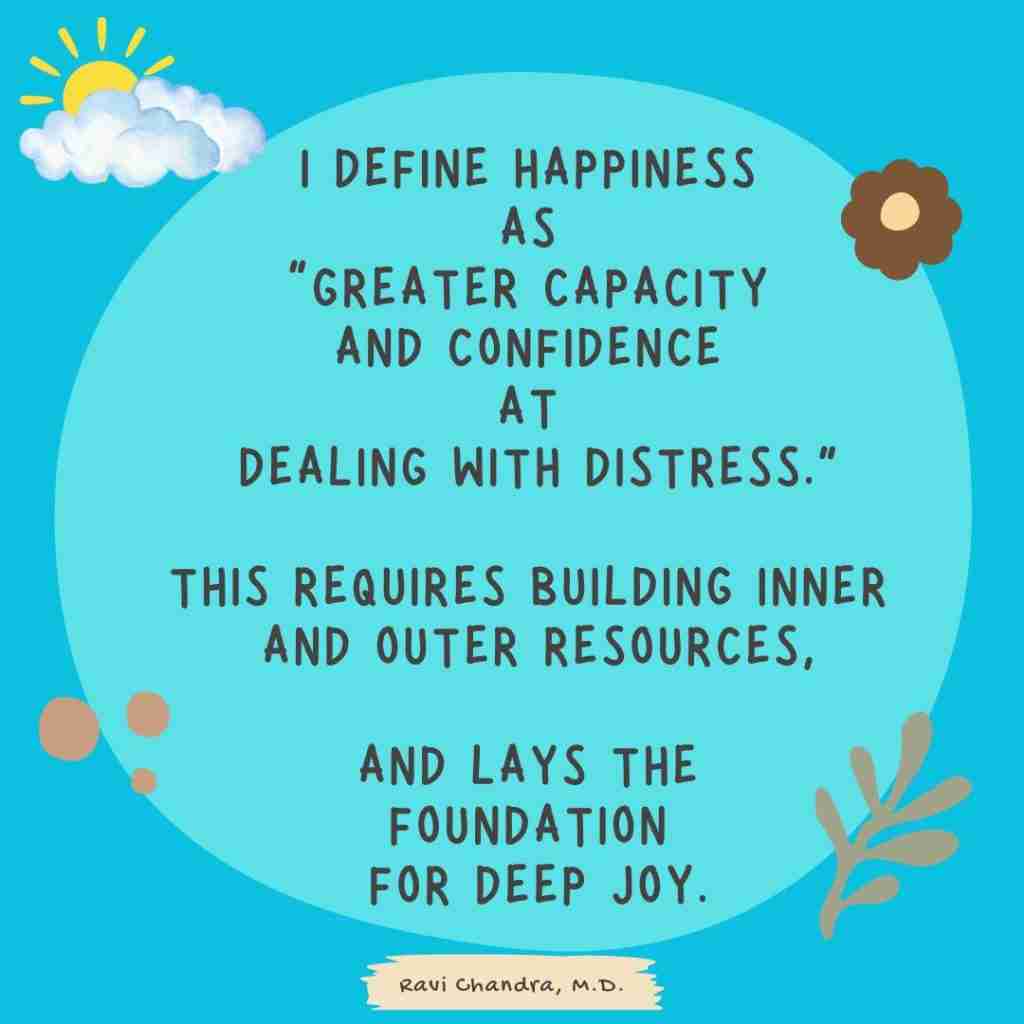
(c) 2024 Ravi Chandra
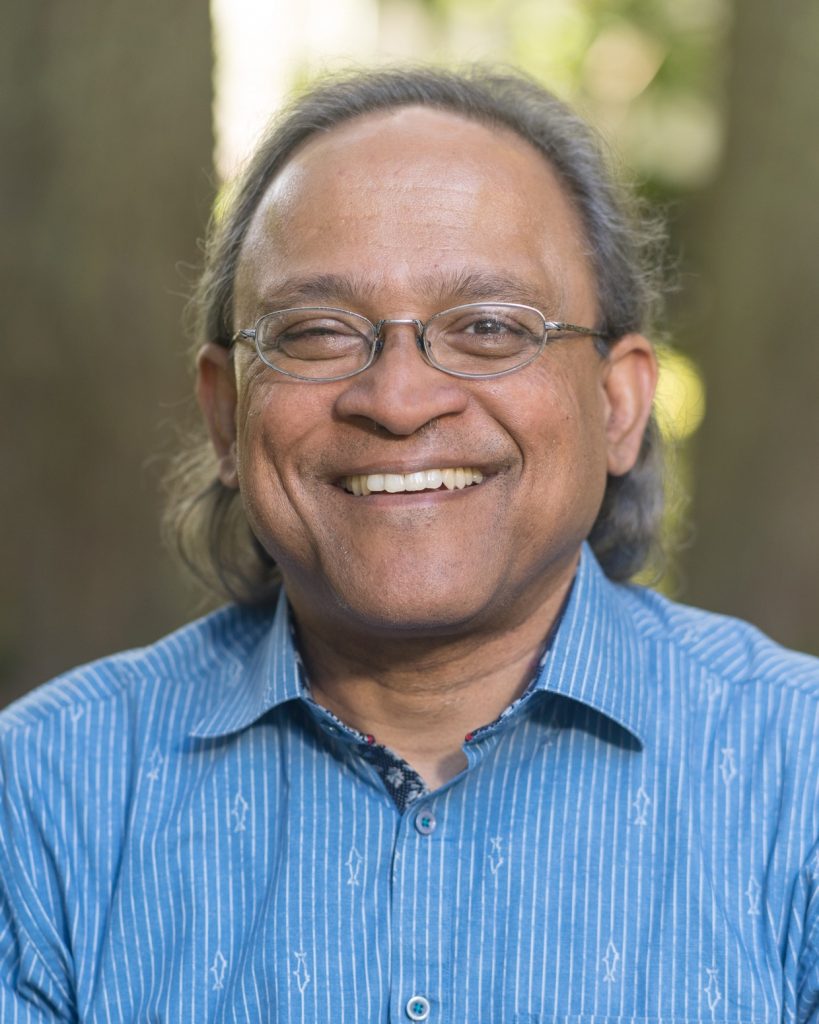
 Photo by Bob Hsiang, 2022
And from Thich Nhat Hanh:
Someone asked me, “Aren’t you worried about the state of the world?” I allowed myself to breathe and then I said “what is most important is not to alow your anxiety about what happens in the world to fill your heart. If your heart is filled with anxiety, you will get sick, and you will not be able to help.”
A friend forwarded this from Rebecca Solnit on November 6, 2024:
They want you to feel powerless and to surrender and to let them trample everything and you are not going to let them. You are not giving up, and neither am I. The fact that we cannot save everything does not mean we cannot save anything and everything we can save is worth saving. You may need to grieve or scream or take time off, but you have a role no matter what, and right now good friends and good principles are worth gathering in. Remember what you love. Remember what loves you. Remember in this tide of hate what love is. The pain you feel is because of what you love.
The Wobblies used to say don’t mourn, organize, but you can do both at once and you don’t have to organize right away in this moment of furious mourning. You can be heartbroken or furious or both at once; you can scream in your car or on a cliff; you can also get up tomorrow and water the flowerpots and call someone who’s upset and check your equipment for going onward.
A lot of us are going to come under direct attack, and a lot of us are going to resist by building solidarity and sanctuary. Gather up your resources, the metaphysical ones that are heart and soul and care, as well as the practical ones.
People kept the faith in the dictatorships of South America in the 1970s and 1980s, in the East Bloc countries and the USSR, women are protesting right now in Iran and people there are writing poetry. There is no alternative to persevering, and that does not require you to feel good. You can keep walking whether it’s sunny or raining. Take care of yourself and remember that taking care of something else is an important part of taking care of yourself, because you are interwoven with the ten trillion things in this single garment of destiny that has been stained and torn, but is still being woven and mended and washed.
–Rebecca Solnit