Jon Jang – Sounds of Struggle – Part X (The Conclusion)
Come Full Circle, Squaring the Circle (A reprise of Act IX)
by Jon Jang. Posted June 17, 2019.
For Baby Boomer Generation Asian American composer-improvisers such as Fred Ho, Francis Wong, Glenn Horiuchi and I who grew up in the white middle suburbs during the 1960s and 70s, we were in a position of “honorary white” or the model minority status without being called that.
While we were all inspired by recordings of black arts music of resistance and books about black revolutionary political thought, it was through the lens of white privilege suburbia. We had no relationship to the black communities. Because the four of us rarely participated in high school dance events, it limited our physical relationship to the music. After I dropped out of UC Berkeley, I did join a band performing music from Donny Hathaway’s Live album. That experience gave me a heavy dosage of soul and the black church. During my Oberlin student years, I later rejected using a metronome after my mentor Dr. Wendell Logan gave me the Charles Mingus explanation of his concept of time as “beats in a circle.”
During a rehearsal of the Jon Jang 4 in One Quartet in preparation for our first recording in 1986, black double bass performer James Lewis made this statement directed at Fred, Francis and me: “You (Asian American) cats sound too intellectual. You don’t have any blues in your music.” After Lewis made that statement, I was fortunate to have the opportunity to substitute for Percy Scott in a blues band directed by Yancie Taylor featuring vocalist Mickey Lynn. Because Percy was on tour with the Whispers, I got the golden and blues opportunity to perform in the “joints” in Oakland such as the Fifth Amendment and the Serenader during the late 1980s. Was that a learning lesson! As the only non-black person in the joints, I was on a huge but modest black music stage performing the “real” blues. Growing up in white Palo Alto, the blues bands that were popular in high school were white male groups led by the Paul Butterfield Blues Band and John Mayall and the Bluesbreakers. This was much different. Blues is black people’s music. I really felt it. It wasn’t just about the black musicians performing the music and that’s important in itself. It was also about the black audience feeling it with them. It was a different kind of experience than listening to a recording or attending a concert with the James Cotton Blues (black) Band performing to a white audience. I may not be able to perform the blues the way it is supposed to feel, but I know and feel the difference. I know Fred Ho was influenced by a white jazz blues group called Blood, Sweat and Tears. But I never felt Fred ever reached that level of understanding about what the blues was about in its real context because he didn’t have that experience and perhaps he didn’t want to embrace that experience.
Composer-improvisers and the League of Revolutionary of Struggle cadres Fred Ho, Francis Wong, Glenn Horiuchi and I embarked on a “Long March” to the beat of a different drum, somewhere between Japanese American taiko, Chinese American lion dance and Max Roach. We were not interested in playing jazz standards as sidemen (middle management or the hired help) or as leaders in jazz clubs because this was simply not our thing. As an Asian American leading music ensemble with black musicians, I was often conscious of making an effort to respect the musicians as leaders and shareholders in the democratic music making process of our work and NOT seeing them as the “hired help.”
For those of us who made it this far as to where we were to where we are now, we were initially met with a considerable amount of skepticism. As far as our early relationship to the music field and the League of Revolutionary Struggle, we were 4 square pegs in 4 round holes who did not necessarily fit in any definition or category except how WE continually define and redefine ourselves. But now, like a Chinese coin, we are no longer square pegs in a round hole. Then and now, we as WAGAM (We Asians are great at math) were squaring the circle in trying to explore and act upon the possible despite being surrounded by a force of skepticism that what we aspired to create was impossible. Sometimes we were outside the circle. Sometimes we were inside the circle – like Mingus’ beats in a circle. There is no time signature for the mathematical constant, pi.
Act X
The Ho Way or the Highway
Why couldn’t I hang with Fred Ho?
“Appearances can be deceiving.”
Aesop
Putting Fred Ho’s ostentatious outlier appearances aside, I will contradict myself by arguing that Fred was a square peg in a square hole both musically and politically. In reality, I could no longer tolerate his rigid binary typology practice of judging people as either revolutionaries or “sellouts.” When Fred explained to me why he chose Sociology as his major at Harvard University, he said it was the easiest way for him to obtain the Harvard prestige. For me, my passion guided me. I just wanted to focus my time on music through the piano. The Oberlin Conservatory of Music Piano Performance major degree served as a record for my driving passion for music. Fred and I had different goals for what we wanted to get out of our college years. From the song, Everyday People, by Sly and the Family Stone, “Different strokes for different folks.”
As cadres in the League of Revolutionary Struggle, Fred imagined himself as a great revolutionary artist leader and treated the League as part of his prestige package like he did with his Harvard degree. I just wanted to play a part in the organization to help build a revolutionary movement in the United States. Like Duke Ellington’s democratic statement about leading his orchestra, “I am just another one in the band.”
There is no question that Fred Ho was highly intelligent. But his obsessive compulsive practice of finger-pointing and blaming the monopoly capitalist system, the League of Revolutionary Struggle and others, as the causes for him to be the victim were easy answers devoid of reality. Because highly intelligent Fred was as rigid as playing to a metronome, he lacked a nuanced understanding and grit. Four of those virtues of grit that Fred lacked were intellectual humility, intellectual carefulness, intellectual thoroughness and open-mindedness. Sadly, because Fred lacked those virtues and clueless to those realities surrounding his life, he was incapable of self-reflection and could not “turn pain into power.” He was at war with himself. In a way, I felt sorry for him. I could no longer invest in a friendship with Fred because friendship should be motivated by love not obligation nor blind loyalty. I had no desire to be one of “Fred’s Yes Men.” It wasn’t just about Fred’s rigid and stifling practice on politics. That was a part of it. It was more about the music. I didn’t feel Fred could feel how I felt about discovering who I am through the depth of the music. I was an artist first who was inspired by Paul Robeson.
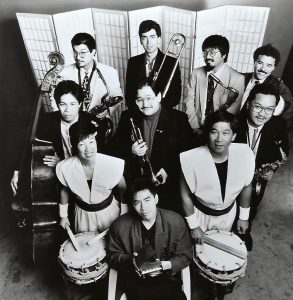
 Fred Ho (top left) was part of Jon Jang’s Reparations Now! ensemble.
At the memorial tribute to Fred at the Oakland Asian Cultural Center (OACC) in September 2014, I only came because I did not want to be a distraction by drawing attention as to why I didn’t come. I wanted it to be all about Fred. I also felt strongly about not performing on the poor quality piano because it would be a reminder of too many awful experiences of tolerating terrible pianos during my emerging artist years. Performing on those pianos felt like being an advanced level swimmer swimming in mud. I initially resigned myself to speaking about the four benchmarks that Fred and I shared. Coincidently, all four benchmarks happened in September during the Chinese Lunar New Year of the Horse:
1966 The Founding of the Star Trek television series
1978 The Founding of the League of Revolutionary Struggle
1990 The Dissolution of the League of Revolutionary Struggle
2014 Jon Jang’s Tribute to Fred’s Final Frontier at OACC
Although I did not plan on performing on that terrible piano, I felt compelled to perform the Star Trek music theme on piano with my improvised alteration of the opening narration that I called Fred’s Final Frontier. The most real thing about Fred to me was that he was a Trekkie. Fred was particularly obsessive about identifying with the Mr. Spock character.
Fred’s imagination of being a great revolutionary artist leader did not seem real to me. After the Dissolution of the League of Revolutionary Struggle in 1990, a mutual friend of Fred and I from the East Coast called me on the telephone informing me that Fred had sent a letter to her naming me a sellout. She also said our other mutual friends have received the same letter. I laughed and responded to her, “If I am a sellout, I am certainly not very good at it based on my lack of celebrity status recognition and earned income. I may no longer be a Yo Yo Mao, but I certainly have not attained the status of a Yo Yo Ma!” (Laughter).
I was glad Fred’s sister Florence was there. Florence offered an anecdote about sharing a meal with Fred: “I am sure you all shared an experience with Fred when he would politely ask you if you were finished eating your meal. After you answered yes, Fred would politely ask if he could eat the leftover food on your plate.” That was my early experiences with Fred! Because I paid for all of his meals in exchange for Fred covering his own airfare to come to the Bay Area to make a recording with me, Fred would eat everything on both of our plates with no speck of food in sight! Because I am left-handed, I will give a left-handed compliment to Fred: Fred is more “left” over me because he eats all the leftovers!
When it comes down to sharing meals with Fred Ho, I am more of a “leftout” than a “sellout.”
Act XI
No Shit! It’s About Grit!
Of the four of us, I feel Francis Wong embodies what it means to have a lot of grit. In addition to those aforementioned qualities that Fred Ho lacked, Francis exudes the qualities of curiosity, intellectual autonomy, attentiveness, intellectual courage and intellectual tenacity. That’s why Francis has a long history of being a leader in many communities because he got grit. In my younger years, I could have gone down the dark path and become an appendage of Fred Ho. I saw that coming. Fred treated all of the musicians in his ensembles as the hired help. One musician, who is an innovator/saxophonist in his own right, was fined for being late at the check-in before a concert. He explained to me, “Now I understand my relationship with Fred: I don’t work with him. I work for him.” I felt I could never go there. That wasn’t me and that wasn’t what the music is about. James Baldwin wrote, “This music was born on the auction blocks of slavery.” The music making process is about the democratic collaborative music making process where musicians work with each other and not as appendages for someone who imagines himself as a great revolutionary artist leader.
The development of my own grit can be attributed to the years that I learned and shared with Francis, James Newton, Joyce Nakamura, Max Roach, Wendell Logan, Amiri Baraka and many others. We have all become capable, ethical and critical citizens who have tried to transform our communities to a better and more meaningful way of life.
It’s a Wrap (Rap)
Interview with Jon Jang
By April Fu
“Be what you seem to be … Never imagine yourself not to be otherwise that what it might appear to others that what you were or might have been was not otherwise than what you had been would have appeared to them to be otherwise.” – Alice’s Adventures in Wonderland by Lewis Carroll
“My father’s approach to politics had a very personal style too. He was certainly political, but he never was, nor would he allow himself to become, a politician. He would never run for office nor be a political leader of a movement. He never considered himself in these roles – in fact he believed that accepting them would violate his own personal integrity, and that is something he never did under any circumstances It is therefore simply academic to argue whether he could have or should attempted to play either one of these roles at one time or another. They were not ‘his thing.’ He resolved the conflict between artist and politician quite simply – he was always an artist and never a politician.”
Paul Robeson: Black Warrior by Paul Robeson, Jr. from the book, Paul Robeson: The Great Forerunner by Paul Robeson, Jr.
Interviewer: Thank you for sharing a part of your incredible history as an Asian American political musician. Your story is quite fascinating and you shared some great quotes from people I never heard of. Could you explain to us the relationship between your music and the work of the League of the Revolutionary of Struggle?
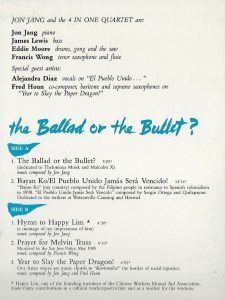
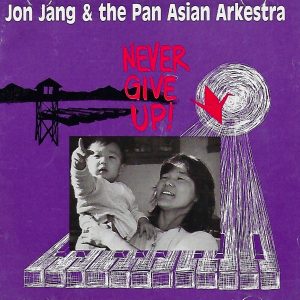
JJ: During the 1980s, most of my music was informed by the tradition of black arts music of resistance and served as a musical diary of the mass movement work of the League of Revolutionary of Struggle. Works such as Are You Chinese or Charlie Chan? /East Wind, Hymn to Happy Lim, Year to Slay the Paper Dragon, Ang Bayon Ko, Reparations Now! Concerto for Large Ensemble and Taiko, Never Give Up! and Butterfly Lovers Song all came out of the mass movement work by Asian American activists where there was a strong presence of cadres from the LRS who worked together with non-LRS activists as part of our united front work.
The LRS translated and redefined united front, a Marxist-Leninist term, into the contemporary political context of the mass movement work, whether it was the coalition work of NCRR or the Rainbow Coalition. “Mr. East Wind” (East Wind Editor Eddie Wong) explained that the united front tactic was a means to “unite all that can be united at the highest political level” to fight for justice and equality. United front was not a tactic, a military term, to overthrow an enemy. This was about embracing a new attitude (“from the masses to the masses”) in our work with Asian American Movement and other mass organizations in the SF Bay Area and the South Bay that would cast a wide net that included East Wind magazine, Chinese Progressive Association (CPA), National Asian American Telecommunications Association (NAATA), Gabriella, National Coalition for Redress and Reparations (NCRR), Nihonmachi Outreach Committee (NOC), Asian American university and college student organizations as well as our work in the multi-racial Rainbow Coalition, the anti-apartheid movement in South Africa and the US anti-intervention in Central America movement.
Interviewer: Did the League of Revolutionary Struggle assign you to compose these works with those political themes?
JJ: No, No and No and I’m no No-No boy. I acted or improvised on MY own with a tremendous amount of moral support from Francis Wong, who was then more valued for his important leadership skills than his cultural work until I ruined him: Francis became both a leader and an artist of HIS own making! Francis and I were kind of like “in a league of our own” so to speak and sing, but “not out of our League.” We were inspired by Amiri Baraka.
Secondly, out of the 3,000 members in the LRS, I was the only outlier member who graduated from a music conservatory according to an anonymous leader in the LRS. I wondered what were the LRS leadership reactions to the title of one of my compositions, Are You Chinese or Charlie Chan? I speculate that they may have preferred a more accessible to the masses title such as The Ballad of Chol Soo Lee by Robert Kikuchi-Yngogo, who was not a LRS member and was seriously committed to Est (Erhard Seminars Training). But seriously speaking, there will be diverse responses just as there are diverse responses in real life. Some people get it strongly, some people get it mildly, some people don’t get it and don’t relate to it, and some people don’t get it and are not interested in relating to it. These are the nuances in life and music We are all not the same. But in our American culture, we want to be accepted by thinking the same way. If I had my say and my way, I would rename the LRS as the League of Real Struggles because I feel the League’s body of work and practice during the mid 80s to its dissolution was not about putting ourselves as revolutionaries “ahead” or “in front” of the mass movement work but playing an integral role in the work itself.
Interviewer: Do you consider yourself a political artist?
JJ: The answer is no, no and no and don’t call me Dr. No. Do you consider Max Roach a political artist because he composed We Insist! Freedom Now Suite or Charles Mingus Fables of Faubus? What about black composer William Grant Still’s cantata And They Lynched Him on a Tree? I reject the term political artist. Because I am an American musician, who is an American born Chinese of the baby boomer generation, I express my personal life and my history through respecting (black) American music and all of its music and history and its relationships to other musics and histories. Music comes through me not to me.
Interviewer: I am not familiar with those musicians that you named. Here’s another question. Are you one of the pioneers of Asian American Jazz?
JJ: No, no and no and don’t call me Dr. No or No-No boy. I am one of the contributors from the baby boomer generation who encouraged new directions in music by Asian Americans that was part of the history of creative music making by American born Asian composer-improvisers at the San Francisco Asian American jazz festivals during the 1980s. As a practitioner who is not an academic, I do not FEEL there is an Asian American jazz aesthetic. If there is an Asian American jazz aesthetic, are there dance movements related to the music as there are in the tradition of black music and Afro-Cuban music. If there is an Asian American jazz aesthetic, are there songs sung in Asian languages as there is in Spanish in the Afro-Cuban tradition. It could happen someday on a national and international level, but it’s far from being there.
Interviewer: Are you a jazz musician?
JJ: No, no and no and black music is NO-ble. If you reread my essay at the beginning, you’ll notice that black writers, as well as two white writers, describe black people’s music as black music or black American music or music by black Americans. Jazz is a slave name created by the white American media intended to disrespect black people and their music as inferior. One of the working titles of a Max Roach autobiography is Jazz is a Four Letter Word. Max explained to me that the word jazz had its origins and references to fornication and prostitution practiced in the brothels and bordellos in New Orleans during the 1920s. Max explained, “I don’t play jazz. I perform the music of Max Roach, Charlie Parker, Clifford Brown and Jon Jang.” In his autobiography entitled Music is My Mistress, Duke Ellington rejects the term jazz a number of times in his interview located at the end of the book.
Interviewer: As an Asian American jazz musician, what motivated you to compose works for a string quartet and a symphonic orchestra? Is there any jazz in those works?
JJ: First, I am NOT a jazz musician. I am NOT motivated to “play jazz standards” in nightclubs or “classical music” standards. I imagine myself as a Marvel Comic book superhero musician in the future who magically creates musical powers that you would never dream before. Secondly, if you reread my essay in the section about Lisa Lowe’s chapter Heterogeneity, Hybridity, Multiplicity: Asian American Differences from her book, Immigrant Acts: On Asian American Cultural Politics, my musical language is heterogenous: “The making of Asian American culture includes practices that are partly inherited, partly modified, as well as partly invented.” My music is simply the music of Jon Jang. However, there are times where I may identify myself as Asian American only when it is appropriate because I want the audience to know and understand that the term was invented in the political context of resistance. We must honor the student activists such as Yuji Ichioka, who later became a prominent scholar at UCLA, and others for changing the narrative from the despised oriental (inferior) term to Asian American as part of the Yellow Power attitude inspired by the Black Panther Party and the Black Power Movement during the Third World student strikes at SF State College in 1968 and UC Berkeley in 1969.
And to address your question about what motivated Jon Jang, the COMPOSER, to write works for a string quartet and a symphonic orchestra, it was William Grant Still’s Afro-American Symphony that inspired me to compose the Chinese American Symphony. In 1945, Leopold Stokowski wrote about black composer William Grant Still as “one of our greatest American composers.” My close friend black composer James Newton and black composer and mentor Wendell Logan encouraged me to compose classical music works about Chinese American history shared in the same way that black composers compose works about black history in America.
The legacy of black American composers has a long history that includes a short list of William Grant Still, TJ Anderson, Hale Smith, George Walker, Florence Price, Dorothy Rudd Moore, Olly Wilson and Wendell Logan. As far as today based on my limited information, Jason Kao Hwang The Floating Box, A Story in Chinatown and I are unfortunately the only American born Chinese composes from our generation who have composed music about Chinese American history in the classical music field that I know about. There could be others.
Interviewer: After the League of Revolutionary Struggle dissolved, did your work change and how?
JJ: During the 1990s, I discovered the kinship of sorrow songs in both the Afro-American and Chinese music traditions either through reading essays by Paul Robeson, as well as attending Cantonese Opera performances in San Francisco Chinatown where I learned to compare Cantonese Opera arias with the “lining out” tradition in the black church and realized its kinship. Robeson also acknowledged this kinship in what I considered the most powerful film about Paul Robeson produced by Gil Noble in 1977: Paul Robeson: The Tallest Tree in Our Forest.
After spending a month of studying Beijing Opera during the month of August in 1994 and one week of residency and performances with flutist-composer James Newton in South Africa, James and I were inspired to compose a work to pay tribute to two of the great artists of the 20th Century: Paul Robeson and Mei Lanfang, the great Beijing Opera artist. The work, When Sorrow Turns to Joy – Songlines: The Spiritual Tributary of Paul Robeson and Mei Lanfang was commissioned by Cal Performances -UC Berkeley and the Walker Art Center in Minneapolis. The World Premiere of the work by James Newton and me was performed at Cal Performances on June 1, 2000 at Zellerbach Playhouse. Musicians who performed in this work came from New York, Los Angeles, the Bay Area and Beijing where we brought three artists from a Beijing Opera company.
I also composed a body of works that feature Chinese folk song melodies in a black American music context. Works include Variation on a Sorrow Song of Mengjiang Nu, Woman Shaman of Alishan, Butterfly Lovers Song, Flower Drum Song, Jasmine Among the Magnolias and my first work that featured erhu (Chinese two string violin) in Two Flowers on a Stem.
Note: If you go to this webpage, you will be able to hear sound clips from Two Flowers on a Stem: http://www.camjazz.com/labels/soul-note/jon-jang-sextet/8024709085528-two-flowers-on-a-stem-cd.html